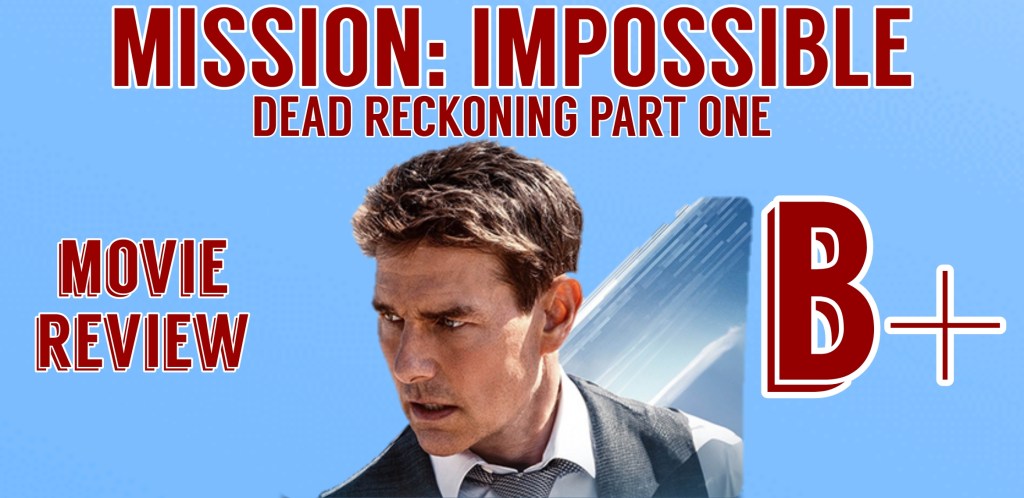
Mission: Impossible – Dead Reckoning Part One hits theaters on July 12.
By I. Simon
In an era where the concept of a Movie Star sadly seems to be dying—with studios instead desperately attempting to milk any and every intellectual property they possibly can for profit, dump virtually everything that isn’t IP-based onto dying streaming services, and even go as far as to now pushing to replace writers, directors, and actors with AI—Tom Cruise feels like the legitimate last of his kind. An actor who is on a virtually impossible mission to save both the theatrical experience and the industry from itself, the lengths he goes to ensure audiences get the best moviegoing experiences they could possibly receive is incredibly admirable, something that no form of soulless technology or a streaming service could provide. Case in point: look no further than the global phenomenon of last year’s Top Gun: Maverick, which not only fully justified its existence despite its terrible predecessor (Tony Scott was a talented filmmaker no doubt, but not even his eye for striking images was able to salvage that utterly vacuous script), but even received universal acclaim from critics and audiences alike in providing a joyful, thrilling, emotionally resonant experience. Despite releasing post-Covid, it played in cinemas for five consecutive months before its physical media release and made nearly $1.5 billion worldwide (only Avatar: The Way of Water, which was as much a director-driven film as Maverick was a star-driven one, surpassed it with a consecutive six months and a $2.32 billion worldwide gross), even going on to receive six Academy Award nominations—including Best Picture and Best Adapted Screenplay—and winning one for Best Sound.
Following Maverick, Cruise once again reteams with Christopher McQuarrie—who has worked in writing, directing, and producing multiple Cruise vehicles, including writing and producing Maverick—for Mission: Impossible – Dead Reckoning Part One, the seventh entry in a franchise that has gone from a flawed yet fascinating method for filmmakers to test out their sensibilities within the big budget playground, to one of the more dependable blockbuster franchises at the moment and a vehicle for Cruise himself to show the lengths he will go to thrill audiences, even if he potentially harms himself in doing so. And unsurprisingly, Cruise and McQuarrie prove to be a highly successful collaborative pair once again, delivering what will most certainly be one of the best studio tentpoles released this year.
That’s not to say Dead Reckoning Part One is free of flaws, unsurprisingly so due to it having to be the first of a two-parter. Though this does at least feel like a singular film with a legitimate sense of closure and I love the choice to make the villain an algorithm (three guesses as to what the villain is a metaphor for), McQuarrie and co-writer Erik Jendresen do occasionally struggle when it comes to implementing the (oftentimes clunky) exposition into the narrative to where you might begin waiting for the next big set-piece or plot development to happen. And speaking of big plot developments, while I will refrain from going into spoiler territory, there is one major narrative turn I found to be incredibly off putting, almost derailing the film for me. It’s less a bold swing and more a lazy writing choice that is far too often an occurrence in these kinds of films, and while I am choosing to give McQuarrie and Jendresen the benefit of the doubt that Part Two will at the very least address this narrative choice in a thoughtful manner, I can’t deny I was immensely frustrated by it, and I expect many other viewers to be upset over it as well.
Fortunately, whatever issues I have with the writing are largely made up by the filmmaking, set-pieces, and performances. To my pleasant surprise, McQuarrie’s visual direction is easily the most dynamic I’ve seen from him to date. His various uses of pans, whip-pans, zooms, tight closeups, extended takes, etc., keeps this energetic and visually captivating throughout—though I did find it odd that the hand-to-hand set-pieces are largely shot in mediums with the occasional cut to a wide—even making many of the exposition-heavy bits more tolerable. As for the set-pieces themselves, while they do inevitably stand in the shadow of this year’s John Wick: Chapter 4, they still impress and thrill here nonetheless, with the highlights being an extended car chase sequence that is both highly comedic and suspenseful in equal measure—even making the great Paris motorcycle set-piece in Mission: Impossible – Fallout look like nothing in comparison—and a borderline terrifying one involving a train near the film’s conclusion. As for the performances, while it is certainly a pleasure to see Cruise on screen once again, I found myself most enjoying the turns of Hayley Atwell, Rebecca Ferguson (her Ilsa Faust is most probably my single favorite character in these films at this point), and Pom Klementieff. Atwell brings a genuinely amusing and charming screen presence to this that a certain superhero franchise never quite allowed her to, while Ferguson and Klementieff both impress with their physicalities and during some of the more dramatic beats.
If Dead Reckoning Part One is, as of currently writing, the weakest of the three Mission: Impossible entries McQuarrie has helmed, then that’s just a further testament to how good he is at making these films, and of course another impressive showcase for Cruise as a Movie Star. At any rate, this is both an incredibly entertaining and very well-crafted action tentpole and McQuarrie’s most impressive direction I’ve seen to date, making me all the more curious as to what he will do with whatever original projects he has been attempting to get off the ground (with the hope that he eventually does). Overall, I greatly enjoyed Dead Reckoning Part One, and I highly recommend seeing it in a cinema on the biggest and loudest screen possible.
I give Mission: Impossible – Dead Reckoning Part One a B+.
 TV and City