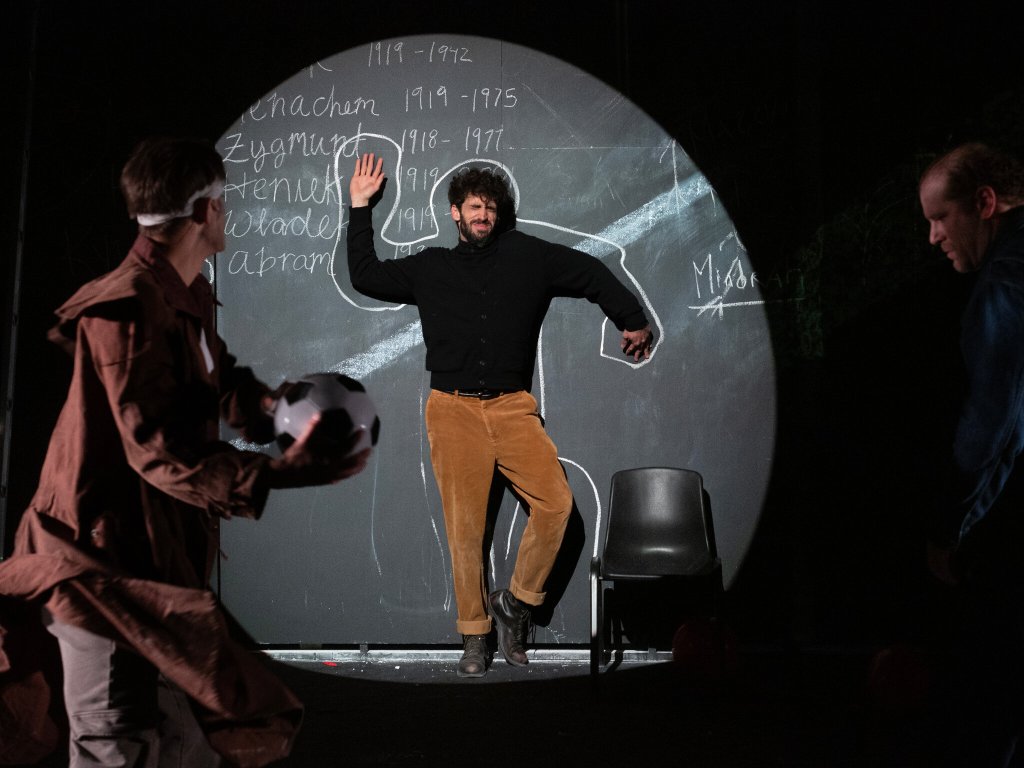
Our Class is playing at the Brooklyn Academy of Music through February 11.
By Rachel M.
Our Class, a three hour play covering the lives of ten characters over 80 years, is, without a doubt, one of the heaviest plays I’ve ever seen. It raises deep questions about the nature of humankind and about hatred of the “other,” which cannot easily be forgotten. It’s for precisely that reason that it is a must-see, and an important contribution to New York theater.
Written by Tadeusz Słobodzianek in Polish, and adapted by Norman Allen, the drama tells the story of ten classmates, some Jewish and some Christian, from the time of their youth, as seeming “friends” through the Sovietization of Poland, World War II and its aftermath, till modern day. It focuses on how the Poles turned on their Jewish neighbors, and committed atrocities against their own classmates. While there are some redeeming characters in the narrative, overall it’s a depressing tale of antisemitism at its worst. The hatred of the Jews runs so deep, that even knowing someone well is not a deterrence to killing them.
The play is unique in its focus not on Nazis, but on the countrymen in Poland. The playwright is unequivocal in placing blame on the Polish characters, and not allowing them to be seen as merely bystanders, or victims of the Germans. The portrayals are raw and powerful.
The backgrounds of the cast adds to the experience, as some of the actors are from Russia or Ukraine, themselves having lived in countries where neighbors can quickly become enemies. The authenticity comes through in their performances. Produced by Sofia Kapkova and Sara Stackhouse and directed by Igor Golyak, (all connected to Arlekin Players Theatre, a company of immigrants, rooted in traditions of classical and contemporary Russian theater) Our Class has the honesty of the European vantage point, while not losing any aspects of the writer’s voice in its translation to English for American audiences.
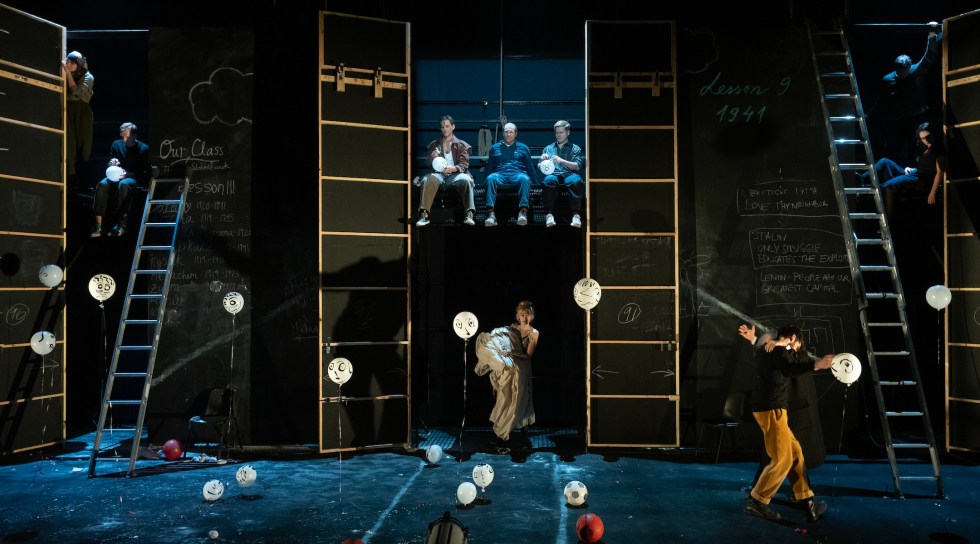
With creative staging and set design, the play moves through eight decades without the transition of scenery and without significant makeup or costume changes. The actors are convincing in aging as the story progresses and the audience becomes attached to their individual stories.
It’s telling that the only character who has living progeny at the end of the play is the classmate who leaves for America early in the story. But sitting in the audience, in the midst of all the antisemitism that is rearing its head in the world today, I could not help but wonder if that next generation isn’t now finding themselves facing the hatred of their neighbors. Our Class is meant to prompt everyone who sees it to contemplate that exact heartbreaking truth. The question is if anything can be done to change the story 80 years later. This is a play that deserves to be seen by as many people as possible.
Find tickets and more information HERE.
 TV and City