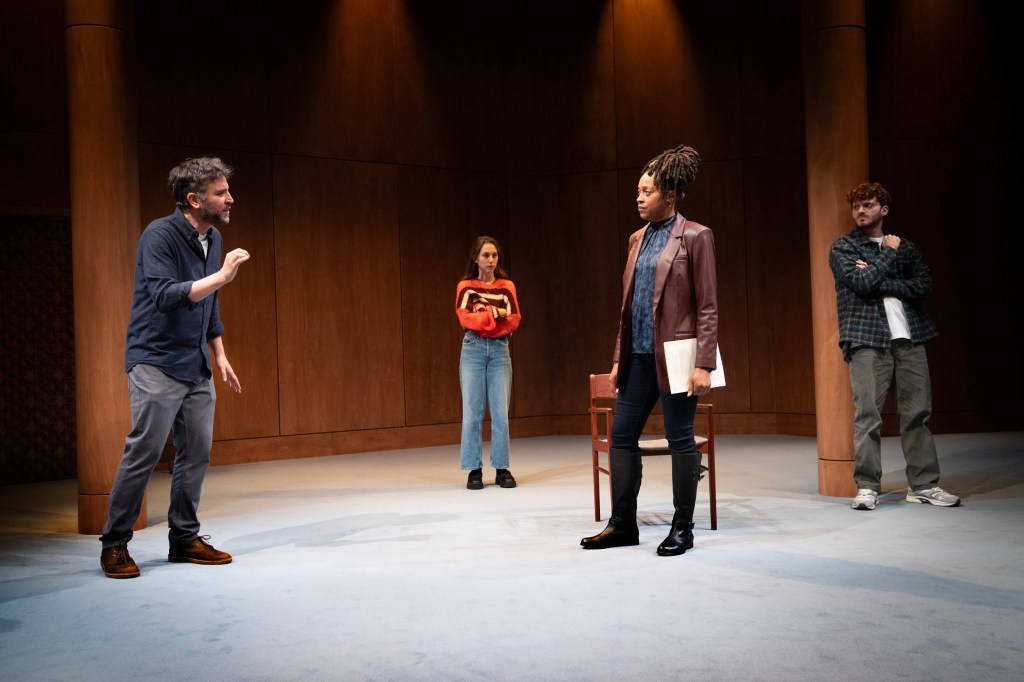
The Ally is in performances at The Public Theater through March 24.
By Elazar Abrahams
I thought I was someone who liked to be challenged by art. The best theater is theater that pushes buttons, and there’s great value in work that is transgressive, bold and unafraid to ask the tough questions. After sitting through Itamar Moses’ new play The Ally, however, I realized that perhaps even I have my limits.
The show begins with an introduction to Asaf, a 40-something liberal arts professor at an unnamed university. He’s originally from Berkeley and his parents are Jewish and Israeli, but he’s an atheist who doesn’t really think much about that small aspect of his larger identity. An African-American student of his, Baron, asks him to sign on to an open letter that is a Black Lives Matter manifesto in everything but name. Asaf is a progressive dude and naturally agrees with 99% of what the letter demands, but a couple sentences buried deep into the pages give him pause. The document, puppeteered by community organizer Nakia who will soon enter the story, mentions Israeli “apartheid,” “genocide,” and calls for an immediate end of all United States aid to Israel.
It’s not even that Asaf disagrees with the specific criticisms leveled at the Jewish state. He’s proudly against the occupation, illegal settlements irk him, and while he definitely thinks “apartheid” is a stretch, he firmly opposes the policies of the current Israeli government. But why is this country the size of New Jersey singled out when the US also funnels cash into plenty of problematic regimes? Why to stand with the Black community, must he also pledge allegiance to an unrelated school of thought? And come to think of it, in this lengthy declaration that spotlights the plights of many minorities and connects their struggles, why are Jews excluded and unmentioned?
After some strife, Asaf ultimately agrees to be listed on the letter, thinking that in a sea of names, who will even notice his presence. And again, he agrees with nearly all that’s written within. What was done as an innocent gesture quickly spirals into a chain of events that make the well-meaning protagonist reckon with his stances, duty to his own posterity, and just how fragile his activism alliances are.
Josh Radnor (of How I Met Your Mother fame) is excellent as Asaf, and he’s matched by a very good cast surrounding him. The monologue deliverers are talented, but it’s the content of the monologues themselves that, sitting in the darkened Anspacher Theater, I found immensely triggering. Triggering is a word I loathe, because if a script is strong enough, theoretically nothing should be taboo. I’m also aware that often, claims that something is not “politically correct” are used to shut down legitimate points of view and stifle healthy debate. But sitting through two acts worth of antisemitism proved challenging, and I think it’s precisely the fact that many of the hate-filled rants that the characters preach from their soap boxes are considered valid opinions and worthy of reckoning with.
There is certainly a moment of catharsis provided towards The Ally’s conclusion, as Asaf finally stands up for himself after a script in which everyone talks at him, recruiting him to their agendas. The antisemitism levied by the characters is at first covert, as when a student asserts that Jewish communities across the Middle East left of their own accord (they were in fact, massacred and forced out), or when a Palestinian student claims that Israel is committing genocide (“Is there a new kind of genocide where the target population doubles?” Asaf eventually retorts). By the end of the play, it’s fully unmasked, when Nakia states point blank that she does not find antisemitism to be a real issue, or when Asaf is told that “when it really costs you something, you can’t put anybody else’s pain before your own.” In another instance, a supposed “progressive” excuses the fact that their friend believes the 9/11 attacks were a Jewish plot.
Yet, despite the fact that many of these characters are knowingly antisemitic or at the very least harbor intense biases towards Jews, The Ally still asks audiences to listen to what they have to say. I cannot even fathom disdain for another ethnic group being excused because the speakers are correct on other issues, even relating to the Palestinians’ right to self-determination. “Is the real problem here that any criticism of Jews, by black people, is off-limits?” is a question asked in the production’s later scenes. That that line will elicit nods and murmurs of agreement from the audience is genuinely terrifying.
Here’s what I’ll say… the play is definitely true to life. This is what actually happens on college campuses across America, and it’s how the younger generation of leftists, even young Jews themselves as is represented in the character of Rachel, feel. It’s only been exacerbated in recent months (The Ally is firmly set in a pre-October 7 world) as Jews are spat on, attacked, and harassed at universities all over the country. Moses’ work captures a depressing reality, and whatever his intentions with the piece are, the lasting effect is that this production gives a “both sides” to that debate.
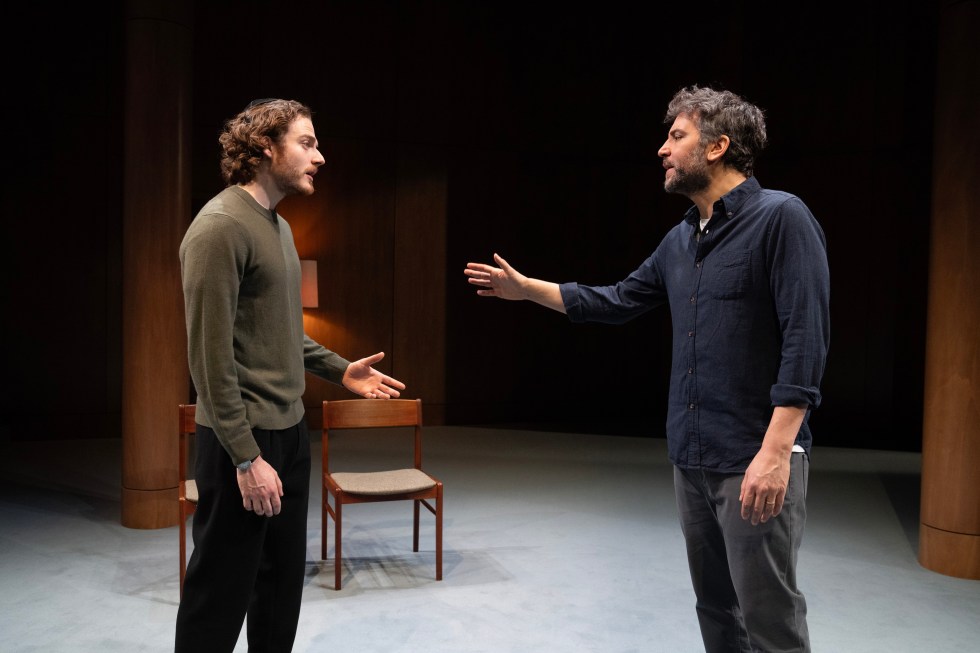
Reuven is a grad student that appears at the closing of the first act to give voice to a “pro-Israel” viewpoint. As the sole religious Jew in the story, he’s portrayed as obnoxious and brash, and very combative towards Asaf (although to be fair, all the characters are obnoxious and brash). He also implies he doesn’t really care about the recent death of a Black man at the hands of police. Lovely. At no fault of the actor portraying him, Reuven has a yarmulke tacked to his head and yet can’t accurately pronounce Hebrew phrases in the cadence that an actual Orthodox Jew would. Again, I must ponder if such flimsy representation of literally any other type of person would make it past a first draft.
For all the uncomfortableness that comes with Reuven’s showcase, he does deliver one line that has stuck with me, and, unwittingly or not, sums up this entire affair: “We Jews do have a long history. A special tradition. It is of nodding sympathetically at the unhinged ravings of those who wish us dead. You’re a man of principle. And I respect that, I do. But I think you will find that you are being taken advantage of. By people who, in fact, hate you.”
Find tickets and more information HERE.
 TV and City