By Elazar Abrahams
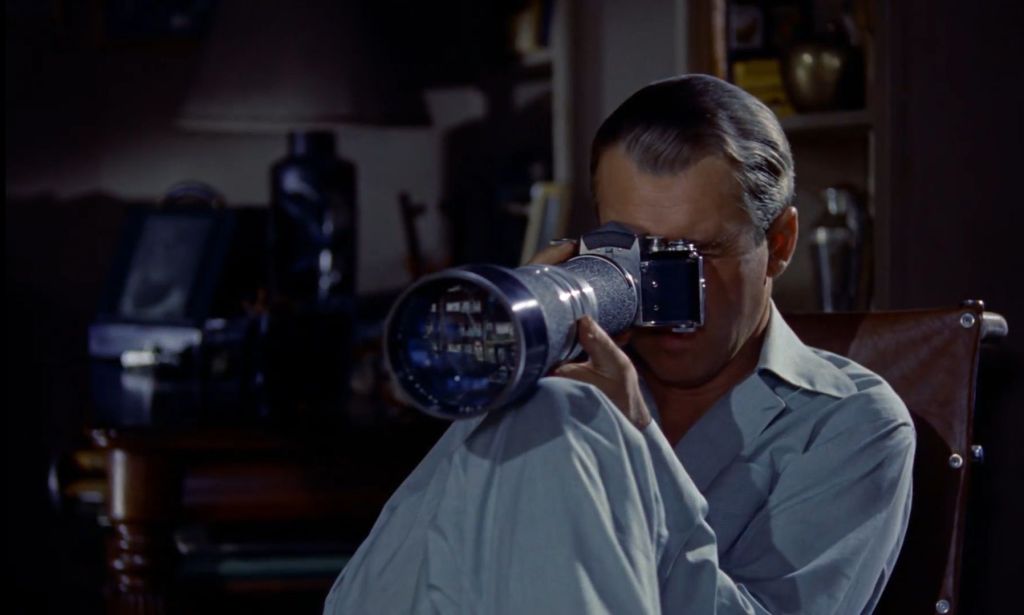
A few years ago, I wrote a paper for a film class, which follows below. The assignment was a frame analysis, a close read of a few seconds from any film on the syllabus up till that point. I chose the above shot from Alfred Hitchcock’s iconic Rear Window. After posting a previous write-up of a shot from Singin’ in the Rain that was well-received, I figured why not share more of those pieces. Good content is good content.
“A cinematic composition must make its impression quickly before it is displaced by another shot,” writes author Bruce Kawin in his book How Movies Work. A talented filmmaker can use a single frame of their film to advance the story and house complex emotion. Director Alfred Hitchcock’s 1954 mystery thriller Rear Window succeeds at achieving frames and shots that, as Kawin says, “can well be thought of as choreography.”
Rear Window follows L.B. “Jeff” Jefferies (James Stewart), a photographer who is wheelchair-bound as he recovers from an injury. He spends his days staring out his fire escape window and at the courtyard in his apartment complex’s backyard, peeping in at the various characters who populate the parallel building. Eventually, Jeff seems to witness a murder and the story escalates from there.
The frame I have selected comes about an hour into the film (1:03:41, to be exact), halfway through the runtime. For the prior sixty minutes, we have watched the backside of the central building along with the protagonist via a plethora of point of view shots. We have seen the woman who sets a place at the table for a man who never comes, the frustrated piano player who bangs his instrument, the sunbather, the newlyweds, the barking dog, and more, all through Jeff’s binoculars and camera. This moment, however, is one of the first times that Hitchcock frames his hero front and center.
This close-up shot of Stewart comes at a point of high tension in the movie, and despite his expression being obstructed by the camera in his hand, the intensity is clear. The image centered in the frame, however, is the camera lens. Because of its central placement, a viewer’s eye is naturally drawn towards it. The background objects in Jeff’s apartment are unimportant and blurry, what matters is his sharp pose in the foreground. The frame is dimly lit because the scene is set at night, which adds to the overall mysterious mood.
On the front lens of the camera, we can see the reflection of the iconic Rear Window set – the lot and windows that we have come to know so well over the course of the film’s first act. Including both Jeff in his apartment and the other building in the same frame makes for a fantastic composition. No matter the scene, the backyard and the characters populating those apartments always loom large.

 TV and City