By Elazar Abrahams
A few years ago, I wrote a paper for a crime fiction class, which follows below. It’s a close read of one of the Coen Brothers’ earliest and best films, Fargo. Good content is good content, so I figured there was nothing to lose by sharing this piece.
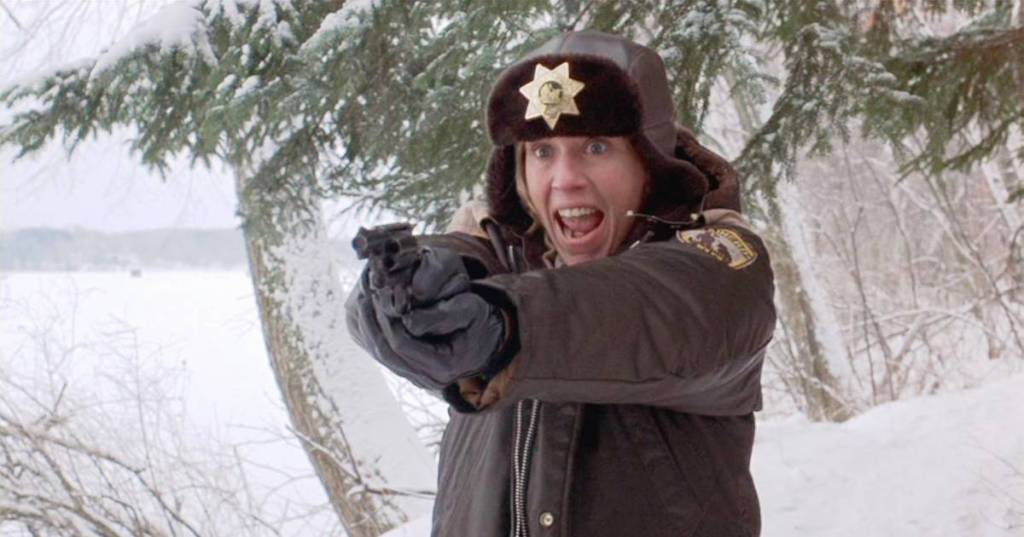
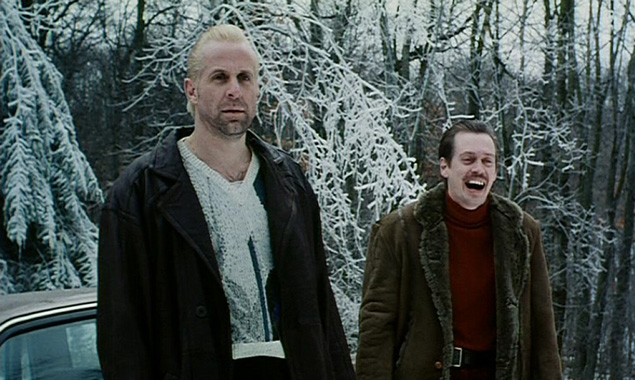
Although on the surface it plays as a standard thriller, a close viewing of the 1996 crime drama Fargo reveals interesting commentary on representations of criminality. Directors Joel and Ethan Coen imbue the story with an almost biblical sense of good versus evil. Righteous morals are embodied by Frances McDormand’s small town police chief Marge Gunderson, whereas ugly criminals Jerry Lundergaard (portrayed by William H. Macy), Carl Showalter (Steve Buscemi), and Gaear Grimsrud (Peter Stormare) are representations of vile sins.
In short, Fargo kicks off with Jerry scheming to kidnap his wife and collect a ransom from his father-in-law. He hires Carl and Gaear to do the dirty work. Unfortunately, what was supposed to be a relatively calm and bloodless job goes horribly wrong and mishaps turn the attempted kidnapping into multiple murders and a situation that keeps spiraling out of control. The crimes attract the attention of Marge, the nearby and noble sheriff, who attempts to solve the killings that fall under her jurisdiction and piece the whole puzzle together to solve the case.
In Fargo, the dividing line between the good characters and the bad characters is firmly drawn. The forces of law and order – Marge – are unequivocally good, while the forces of lawlessness and chaos – Carl, Gaear, and Jerry, are completely evil and unsympathetic. Unlike much mainstream entertainment, the Coen brothers do not glamorize evil in Fargo. To them, crime is negative, ugly, senseless, and stupid.
Each member of the film’s antagonist trio represents criminality and evil in a distinct way. Gaear Grimsrud, the sociopathic serial killer, is almost comically criminal and pure evil. He has virtually no personality, always hungry, and empty-headed. It’s no coincidence his name is “grim.” Carl Showalter is nasty, greedy, cowardly, and “funny looking.” Despite being the only of the three conspirators to empathize with the victims, he is still vicious. Grimsrud kills because it his meathead nature, whereas Showalter is even meaner because he can empathize. In one scene, we see how he takes delight in Jean Lundegaard’s terrified and desperate stumbling through the snow at the cabin hideout.
Of the three criminals, Jerry Lundegaard is arguably the most culpable. In order to get himself out of a financial hole, he is willing to submit his wife to a terrifying kidnapping, to steal from his father-in-law, and to put his son, his neighbors, the police, and everyone in the kidnappers’ path in danger. He is the root cause of Fargo’s five murders, which include his own wife and father-in-law. Fittingly, his crime leads to his own downfall. He is depicted as foolish for believing he could get away with the despicable acts he committed.
It’s worth noting that Jerry’s father-in-law, Wade Gustafson (Harve Presnell), also typifies a sort of criminal, especially in regards to greed. Before the movie even begins, he has refused to give Jerry the money he needs for his investment in the parking lot even though he could easily lend it. Later on, he is remarkably hesitant to pay the million dollars need to rescue his daughter and save her life. This greed leads to his own demise, as Carl shoots him when he, rather than the conspirator Jerry, shows up with the ransom money.
According to Mary Ann Beavis, Professor of Religious Studies at the University of Saskatchewan, in her essay Fargo: A Biblical Morality Play, the trifecta of criminals Jerry, Carl, and Gaear personify the “Seven Deadly Sins” of pride, covetousness, lust, anger, gluttony, envy, and sloth.
Indeed, all three are explicitly greedy for money and all three are prone to fits of anger. In the case of Carl and Gaear, this leads to murderous rage. Additionally, “[Gaear] is a glutton, with an insatiable appetite… Both of the kidnappers, but especially [Carl], are prone to lust (in the guise of visits to prostitutes).” In fact, the entire film hinges on the fact that Jerry is envious of his father-in-law’s wealth, and “covets” the man’s wealth for his own. “All three are slothful… in that they hope to make ‘easy money’ through the plot to hold Lundegaard’s wife for a ransom to be paid by her father.”
Another example of greed is when Showalter picks up the million-dollar ransom from Wade Gustafson, he hides most of it from his partner, and gives him only a fraction of the million dollars. Later, Lundegaard aims to cheat both the criminals and his father-in-law by demanding a much larger ransom than he intends to pay for his wife’s return.
“Similarly,” continues Beavis, “it could be argued that Marge Gunderson represents most of the Seven Moral Virtues that are the counterparts to the seven ‘deadlies.’” In contrast to the greed of the criminals, Marge is temperate, self-controlled, and faithful in her relationships with her colleagues, and especially in her relationship with her loving husband, Norm. The virtues of love, kindness and generosity are played out in Marge’s intimate relationship with her spouse, and in the couple’s anticipation of the birth of their child. She shows herself to be impervious the sin of lust when she is confronted with a man who obviously wants to seduce her. Marge shows zeal (the opposite of the criminals’ sloth) in her professional and determined approach to her job, at which she excels. She also displays humility, in that she is “completely unpretentious about the achievement of rising to the rank of police chief.”
It’s true. Marge functions as the antithesis of criminality. She embodies law and order and pure family values. The Coens’ statement on the depravity of criminal types is only made stronger by the film’s inclusion of her as an angelic foil.
Marge is even incapable of understanding the motivation to commit crimes, as shown in her final speech to Grimsrud:
“So, I guess that was Mrs. Lundegaard on the floor in there. And I guess that was your accomplice in the woodchipper. And those three people in Brainerd. And for what? For a little bit of money. There’s more to life than a little money, ya know. Don’t you know that? And here you are; and it’s a beautiful day. Well, I just don’t understand it.”
In context of the scene in question, this declaration is almost like a sermon. Reminiscent of the Book of Job, Margie concedes that the “wellsprings of evil” are ultimately “mysterious and inexplicable by human reason and everyday decency.”
The stark contrast between the film’s protagonist and antagonists hint at a deeper meaning intended by the directors. “The black-and-white world view of the movie can easily and substantively be connected with major biblical themes and values,” Beavis states. “The hero, Margie, personifies law, wisdom, and family. The criminals personify lawlessness, foolishness, greed; and, in the case of Jerry Lundegaard, betrayal of family.”
Interestingly, the Fargo anthology television series expands on the religious themes laid out in the movie. In the fourth episode of the first season, we meet Stavros Milos (Oliver Platt), a Greek-American man driving to Minnesota to seek fortune. His car breaks down and he is stranded in the frozen wasteland alone. By “chance,” he spots a red ice scraper just barely sticking out in the snow-covered ground – the same ice scraper that Carl and Gaear left to mark the location of the ransom money (but were never able to return to) during the events of the film. While viewers can connect the dots and see the remarkable coincidence showrunner Noah Hawley has concocted, to the character of Stavros, the discovery of this large sum of cash is definitive proof that God is real.
Years later, Stavros is a devoutly religious man, and yet a criminal. The fortune he found in the snow started him off, but since then his practices as the self-proclaimed “supermarket king of Minnesota” are questionable at best and downright illegal at worst. Much like the criminals in the film, Stavros is in for a comeuppance. He is haunted by variations on the ten plagues of Egypt such as a a blizzard that turns into a rain of fish and an attack that kills both his most trusted bodyguard and his firstborn son.
As former A.V. Club television critic Emily VanDerWerff notes in her column entitled ‘God in the details: The dark drama looks heavenward,’ Fargo, both the film and miniseries, seem “intent on setting up this dichotomy between good and evil, order (or structure) and chaos.”
Reviewing the fifth and sixth episode, VanDerWerff hones in on a scene where Deputy Molly Solverson (Allison Tolman), a Marge-like figure, enters the home of murderer Lester Nygaard (Martin Freeman) without a warrant. She usually abides by the rules, but she is desperate to find the murder weapon that will finally prove that Lester killed his wife. When she searches the home top to bottom, she finds nothing. Offscreen, Lester has moved the object in question (a bloody hammer) to an undisclosed location. “As with so much of Fargo,” VanDerWerdff writes, “this is about moral instruction: Molly will get her man only when she follows her own code exactly, only when she doesn’t get waylaid from her path by good intentions.”
Film analyst Keith Phipps, discussing Fargo for The Dissolve, posits another interesting theory about how the Coens represent the nature of criminality. “Fargo is above all a story of greed and discontent, a film filled with characters who always want more than they have, and will do what it takes to get it,” he writes. “Marge isn’t one of those people, but that doesn’t mean she’s immune to the same instincts.” She uses the “codes of Minnesota nice to cut through Jerry’s defenses, and follows clues that others miss.” Marge is just as fast, instinctive, and cunning as the movie’s criminals – in fact, they look quite dumb in comparison. Taking the traditional character traits of a criminal mastermind and placing them in the hands of the story’s hero, while the bad guys are not the “sharpest tools in the shed” is another way in which Fargo makes its case against crime.
Within its brisk hour and 38-minute runtime, Fargo manages to touch on other aspects of criminality as well. For example, you can view the story as a commentary on the pitfalls of toxic masculinity and its subsequent path to criminal behavior. The plot’s chain of events is all set in motion because Jerry is convinced the ransom money will establish him as his own, not just the lame “boss’ daughter.” Lundergaard desperately yearns for respect, but we see Wade and Wade’s business partner verbally abuse him at every opportunity. It’s clear that Jerry is pathetic and emasculated. Additionally, explains film journalist Noel Murray in The Dissolve’s same retrospective of Fargo, Wade fits this narrative as well, being that he insists on delivering the ransom money himself as if to prove his manhood. He dies as a result. Writes Murray, “I suspect Wade might have felt it was worth it, that losing his own life was an acceptable price to pay to emasculate his stupid hump of a son-in-law one last time.” We also see that Norm Gunderson (John Carroll Lynch), Marge’s wife, is gentle, kind, and far from criminal. It’s yet another juxtaposition of criminal versus lawful and the traits that make us so.
When analyzing Fargo, we cannot ignore the film’s midwestern setting and what it has to say about criminality and human nature. It is obvious that the directors, Minnesota natives themselves, are getting at something specific about this region and its inhabitants, and perhaps the country at large. Americans from this area are known for their niceness and hospitality, but sometimes the “affable surface can mask desperation, cruelty, and ruthlessness.” Juxtaposing the stereotypically “extremely polite, chipper people” with the dark reality of humanity – the movie’s dismal story about kidnapping, violence, and the worst of human nature, shows that these traits and urgers towards criminal activity lurk within us all. In the words of critic Matt Singer, also of The Dissolve, Fargo loves to “revel in that contrast, and marvel at the full scope of human existence, from extreme cruelty to extreme kindness.”
Perhaps that is why the movie, in its opening moments, claims that “This is a true story. The events depicted in this film took place in Minnesota in 1987. At the request of the survivors, the names have been changed. Out of respect for the dead, the rest has been told exactly as it occurred.” According to The Atlantic, “it’s widely known that the onscreen text that opens the film… was an outright fabrication.” So why pretend that this is a true story? Because it could happen, and it does. Fargo’s representation of criminality is rooted in the real world. Jerrys, Wades, Carls, and Gaears live throughout America, festering in society’s dark underbelly. They seem like nice guys at first glance – Jerry could be a typical father and husband. Yet greed, lust, pride, anger, envy, and the like lead everyday people down an illicit path of no return. Luckily, Marges exist too. Pure hearted folk with noble intentions who will stop the criminals in their tracks.
Fargo is clear that criminality is not something to be emulated. Unlike films like Todd Phillips’ Joker or Alfred Hitchcock’s Strangers on a Train, the criminals are not sympathetic or seductive, and are definitely not anti-heroes. They are unequivocally despicable and not to be emulated. It could be that the entire Fargo functions as a warning, because ultimately, at least in the world of the movie, Joel and Ethan Coen ensure that the criminals lose, and the law-abiding citizens win. Just look at Carl’s fate. He gets shot in the face, almost bleeds to death, and painstakingly crawls through the snow and digs into ice just to hide money that nobody involved in this enterprise will ever find. Marge ends up in bed with her husband, and a child still on the way, sure to be born into a kind and loving home.
In fact, the film’s structure is such that Marge does not even appear on screen until 32 minutes into the movie. Despite that, the closing scene of Fargo revolve around her, and she is centered in the final shot. That is no mistake. Marge Gunderson understands that if you have a home, a job, someone to love, and a good attitude, you are “doin’ okay.” Vice versa, if you lack those important pillars of life, or worse, do not value them, you might, like Jerry Lundergaard, Carl Showalter, and Gaear Grimsrud, turn to a life of crime.
 TV and City