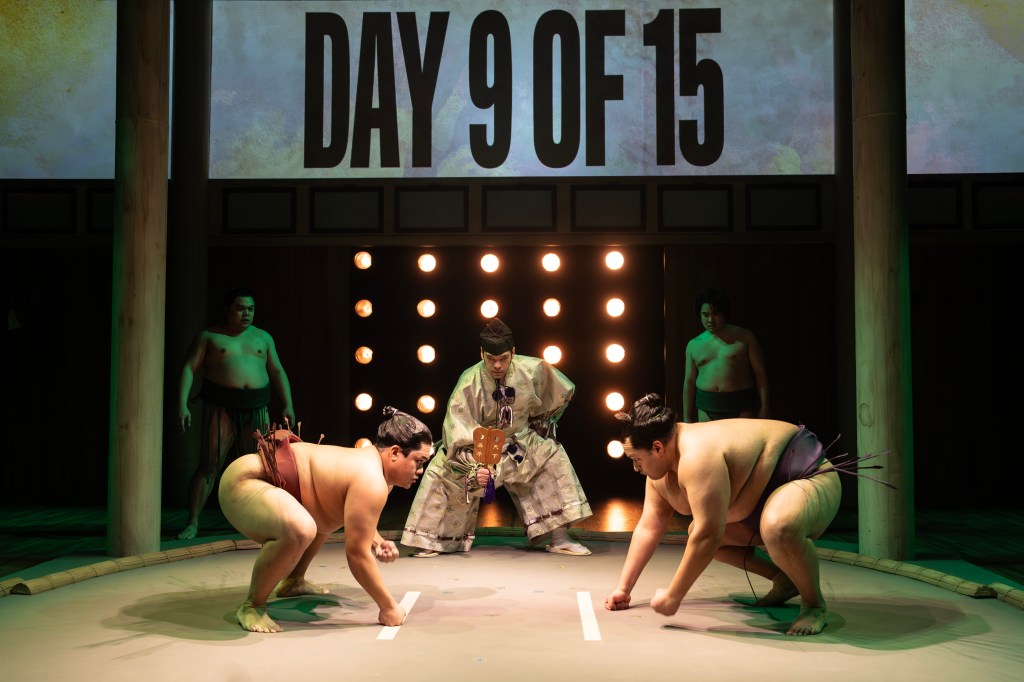
Sumo is now open at the Public Theater and in performances through March 30.
By Richard Bernard
Have you ever seen a play about Sumo wrestling? My guess is probably not. And, until now, neither had I. Did I love this play? Maybe. Did I hate this play? Not remotely. Will I remember this play? Definitely.
Sumo is currently playing at the Public Theater. It is an inventive and ambitious piece. They have created a sumo wrestling ring in the middle of the stage (that doubles as their training facility as well as several instances of competition) and surrounded three sides of the ring with audience seating. The fourth side is the back wall which slides open as doors to a Japanese dojo would.
I do like the way they used the layout of the theater. The actors were entering and exiting from different angles, which kept things interesting. Not only the back door and the side wings but also the two diagonal tunnels that led to the stage. I think this kept the audience on their toes as you never knew when or where an actor was going to appear.
There was also interesting video and lighting effects shown on the back wall and the floor of the stage. It wasn’t as ambitious and IMAX inspired as, say, Redwood (currently on Broadway), but was used in such a way to explain and further along the narrative.
The play begins with a lone Japanese hanging drum (called a taiko) played energetically by a sole musician. This is a great way to start a play! It immediately grabs the audience’s attention. Three narrators then emerge to set the tone of the show. Immediately one makes a joke. This joke disarms the audience. There was audible laughter. Is this a comedy?
The answer to that question is no. Yes, there are definitely humorous aspects to the writing, however, this is a seemingly serious play with serious undertones interjected with occasional bouts of levity.
The narrators attempt to quickly explain a little history on Sumo and introduce the characters around which the play is based. One issue that I had is that this all happened so quickly. And even though there are only nine actors, and five of them are playing the wrestler characters, I kept forgetting their Japanese names. Saying that, there is a noticeable amount of Japanese in this production. Not spoken so much as written. The characters are referred to both by their proper names and their ranking in the Sumo community. Because these are used interchangeably I found it easy to get confused and distracted from the dialogue.
The writing, to me, seems like it’s 75% there but just needs additional polishing. I think my main issue is with character development. Unfortunately, I didn’t find a connection with any of the characters. So when “real life events” are happening outside of the Sumo ring I didn’t feel a visceral response. I don’t believe that it is the fault of the actors, who all did a fine job, particularly Scott Keiji Takeda, who plays the youngest / newest person attempting to eventually become a wrestler, while fighting against various initiations and the dues he must pay as he progresses along his chosen path.
The challenge may be that the playwright is trying to develop too many characters simultaneously. So you never really grab onto one character’s plight, their transition or their journey through the play. You’re trying to juggle five different actors, learning about their life history and potential future in or out of the ring.
The one time that I did find myself rooting for a character was during the actual competition wrestling scenes. Although, I do have to admit, because we have limited actors, playing multiple parts, I did get a little confused who was who at times.
Realistically, Americans don’t have a history with sumo wrestling. There may be some curiosity about it but there’s not a deeper innate connection. It’s possible that this play is aiming to solve that and forge a connection with American audiences about a profession/sport that is essentially foreign to us.
Does it succeed? I think it does but I also think that it can be better. Something is missing that I cannot put my finger on. Maybe it’s difficult to portray warmth and compassion juxtaposed against the mystery, beauty, history and cruelty of the Sumo world? Possibly, but this is a valiant effort, and I have no doubt that I will remember this play for some time.
Find tickets and more information HERE.

 TV and City