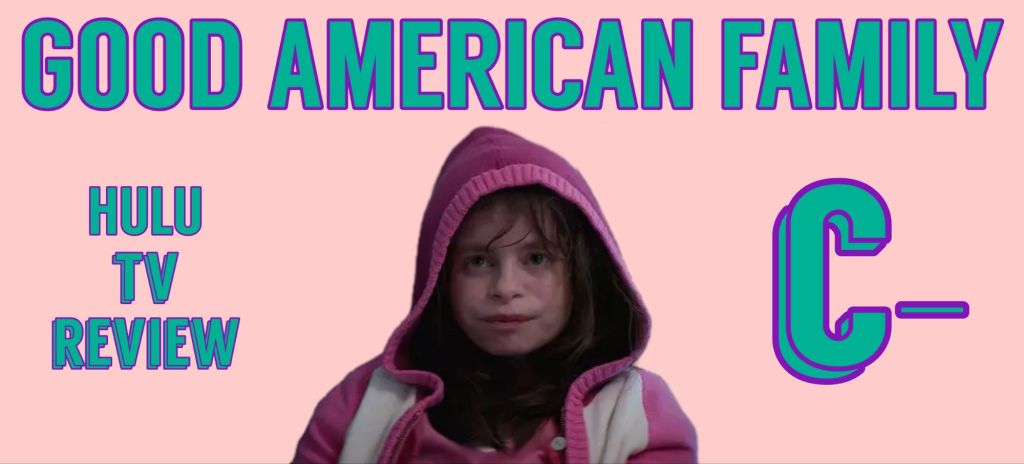
Good American Family premieres March 19 with two episodes, followed by new episodes weekly on Hulu.
By Elazar Abrahams
Hulu’s Good American Family takes on one of the strangest true crime sagas in recent memory, dramatizing the case of Natalia Grace, a Ukrainian orphan with a rare form of dwarfism who was adopted by an Indiana couple and later accused of being an adult pretending to be a child. It’s a story filled with twists, contradictions, and murky truths. Unfortunately, the miniseries struggles to handle that complexity, delivering an uneven and frustrating viewing experience that never quite finds solid footing.
The first half of the series is told from the perspective of Kristine and Michael Barnett (Ellen Pompeo and Mark Duplass), the well-off suburban parents who begin to suspect something sinister about Natalia (Imogen Faith Reid). The way the show presents their claims walks a strange line between psychological thriller and unintentional camp. Some scenes, particularly in the early episodes, make Natalia’s behavior seem exaggeratedly disturbing, turning what should be a grounded drama into something that feels almost like horror.
Midway through the season, Good American Family abruptly shifts to Natalia’s perspective, attempting to reframe the entire story. This could have been an effective way to showcase the contradictions of the case, but the transition feels clumsy and poorly justified. Aside from a brief disclaimer at the start of each episode, the show provides little explanation of its sources, leaving viewers unsure how much of this version of events is based on documented fact. Instead of deepening the mystery or adding nuance, the narrative shift creates more confusion.
Weak performances don’t help matters. Pompeo and Duplass, usually strong performers, struggle with roles that don’t give them much to work with. Their characters are reduced to one-note portrayals of panicked, increasingly erratic parents. Reid’s depiction of Natalia also suffers from the show’s inconsistent tone. In the first few episodes, she is portrayed as unsettling and manipulative, only for the series to later insist she was innocent all along without giving her character a meaningful arc to support that conclusion.
On top of these issues, the season is simply too long. At eight episodes, the pacing drags, stretching out a story that could have been told in half the time. Instead of feeling suspenseful, the show meanders, repeating the same dramatic beats without adding much new insight.
Good American Family has all the elements of a gripping true-crime adaptation but doesn’t know how to put them together. By failing to commit to a consistent tone and offering little clarity on the shifting perspectives, it ends up feeling like a drawn-out dramatization that never quite justifies its existence. There’s a fascinating story at its core, but this version of it isn’t the one worth watching.
I give Good American Family a C-.

 TV and City