Big Mouth’s final season premiered May 23 on Netflix.
By Elazar Abrahams
When Big Mouth premiered on Netflix in 2017, I was still in high school. At the time, I hadn’t experienced anything close to a real relationship, and like a lot of the show’s early fans, I came to it with both curiosity and hesitation. After all, smart comedies that feature an endless array of talking genitalia are few and far between.
Now, as Big Mouth wrapped up with its eighth and final season last week, I’m just a semester away from finishing grad school. In a few months, I’ll be married. I’ve lived a lot of life since Season 1. And I’m still kind of shocked that the show (and I!) made it this far. It’s rare, especially on Netflix, for a series to get this much time and space to evolve. Eight full seasons and even a spinoff in the form of the underrated Human Resources. That kind of breathing room allowed the writers to try wild character pairings, go on tangents, explore emotional arcs deeply, and just have fun being weird.
The final season itself is honestly just fine, and like many of the show’s recent years, not the strongest stretch. There’s a slight shift in energy now that the kids are in high school, and I really appreciated the growth spurt storyline for Nick, who’s spent seven seasons ridiculed as the tiny one. Watching how that physical change reshapes his identity and social life is surprisingly thoughtful. Most of Season 8 feels like typical Big Mouth, with only the last two episodes having a satisfying sense of finality.
For a show so loud, brash, meta, and insistent on constantly breaking its own formula, the actual series finale is rather quiet and subdued. The kids are moving on. Their Hormone Monsters have done their jobs. Puberty is over. And while the characters don’t know exactly what’s next, they’re ready to face it, with the last moments of Big Mouth showcasing the gang bravely walking into a giant white beam of light that represents the unknown future of post-puberty adulthood. As they disappear into the void, the children are all reduced to scribbled outlines. That uncertainty felt real to me.
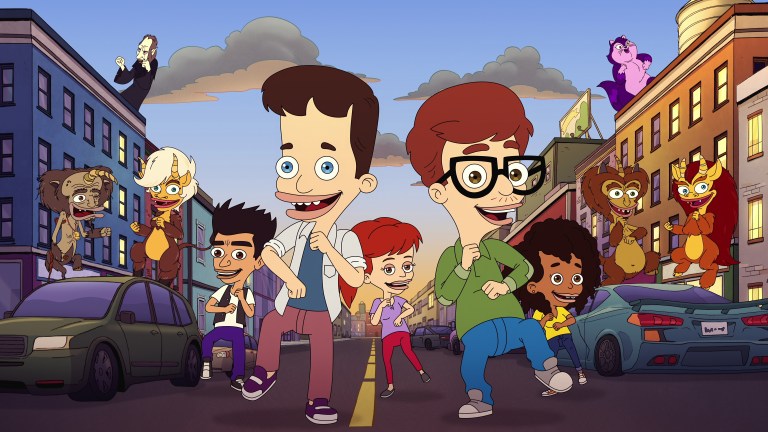
At the heart of Big Mouth was always its genius metaphorical characters. The Hormone Monsters in particular deserve credit for carrying the show across all eight seasons. Whether it was Connie’s wild affirmations, Maury’s chaotic encouragement, or Rick’s incomprehensible muttering, they personified the chaos of adolescence better than any grounded drama ever could. Add in the Shame Wizard, Anxiety Mosquito, Depression Kitty, and more, and you had a literal pantheon of preteen inner turmoil. These characters were hilarious, yes, but they were also tools for understanding real feelings — ones many of us carry well into adulthood. Human Resources spun off to follow them more closely, which speaks to just how compelling those ideas really were. Big Mouth’s fan base was always a complicated one, as many dimwitted fans were there for the “haha, they said penis” moments. Behind the insanely vulgar punchlines, there was real heart to this!
The series wasn’t always consistent. After a stellar run early in its inception, Big Mouth had slumps, and like co-creator Nick Kroll has admitted, the show shifted over time as it became clear that a younger audience was tuning in. That push toward being more explicitly educational, particularly in seasons three and four, didn’t always feel seamless, but it was a noble pivot.
What other show would take an oddball side character like Lola and turn her into a fan favorite with her own emotional arcs? What other animated comedy would let a character like Andrew completely devolve into a caricature of insecurity? Missy’s journey in particular stands out. Her evolving relationship with race, identity, and her parents was something you just wouldn’t expect from the early episodes, yet the show made space for it.
More than anything, I’ll miss the musical numbers. Big Mouth had no business being as musically talented as it was. Whether it was a Shame Wizard ballad or the many puberty anthems the songs were sharp, catchy, and laugh out loud funny.
In a world where most shows end after two or three seasons, Big Mouth stuck around long enough to actually finish its thought. It knew when to call it. And while it probably could have trimmed a season or two along the way, I’m grateful it got the time to experiment, to get strange, and to grow up, just like we all do.

 TV and City