Guns & Moses opens in select theaters on July 18.
By Jack Faivish
With a title like Guns & Moses, you’d be forgiven for assuming director Salvador Litvak’s new film is a parody. But the movie is no joke. A serious action thriller starring Mark Feuerstein, Dermot Mulroney, Neal McDonough, and Christopher Lloyd, the new release blends genre fun with a distinctly Jewish spin, one that’s refreshingly defiant.
The plot follows Rabbi Mo (Feuerstein), a soft-spoken Los Angeles spiritual leader whose quiet life is upended when a member of his community is murdered. What begins as a search for justice turns into something much bigger, as Rabbi Mo uncovers a far-reaching conspiracy that forces him to arm himself and take matters into his own hands, with God and his Glock protecting him.
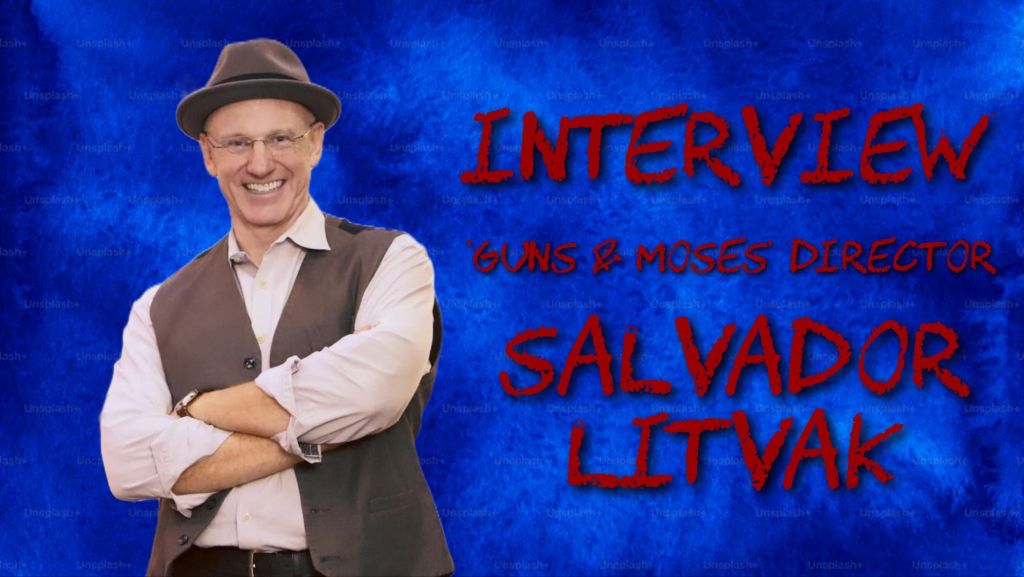
TV and City had the chance to speak with Litvak over Zoom, and it immediately became clear just how much of Guns & Moses comes from personal conviction. “Well, I’m a frum [religious] Jew,” he explained with a smile when asked how the film nailed so many details of Orthodox life. “It was very important to me and my wife, who co-wrote the movie, to keep it authentic. There are so many movies out there with certain types of Jews — the funny Jew, like Adam Sandler or Larry David, who I love, they crack me up — or the dead Jew, there are a lot of Holocaust movies out there. But no movies about Jews who won’t back down.”
That absence in pop culture is exactly what Guns & Moses seeks to correct, and it does so with remarkable attention to detail. Asked about the ways the film nails religious authenticity, from the Hebrew pronunciation, the books on the shelf, the way the characters dress, or even a ‘Thank You Hashem’ car magnet visible during a climactic chase, Litvak said that much of it was personal. Still, as the only religious person on set, it wasn’t always easy. “The menorah we used actually wasn’t the kind a Chabad rabbi would have. I caught it too late. I was juggling a hundred things, and nobody else on the team had an eye for that sort of thing.”
We asked if he had a favorite detail that made it into the final cut, something subtle that only insiders might catch. Without missing a beat, he pointed to a moment near the end of the film: “We shot scenes at Shalom Grill in Pico-Robertson. I love that place. Fun fact: it’s the same restaurant from the Avengers post-credit scene, the one where they’re all eating shawarma. But Marvel didn’t publicize it. We wanted to show it off.”

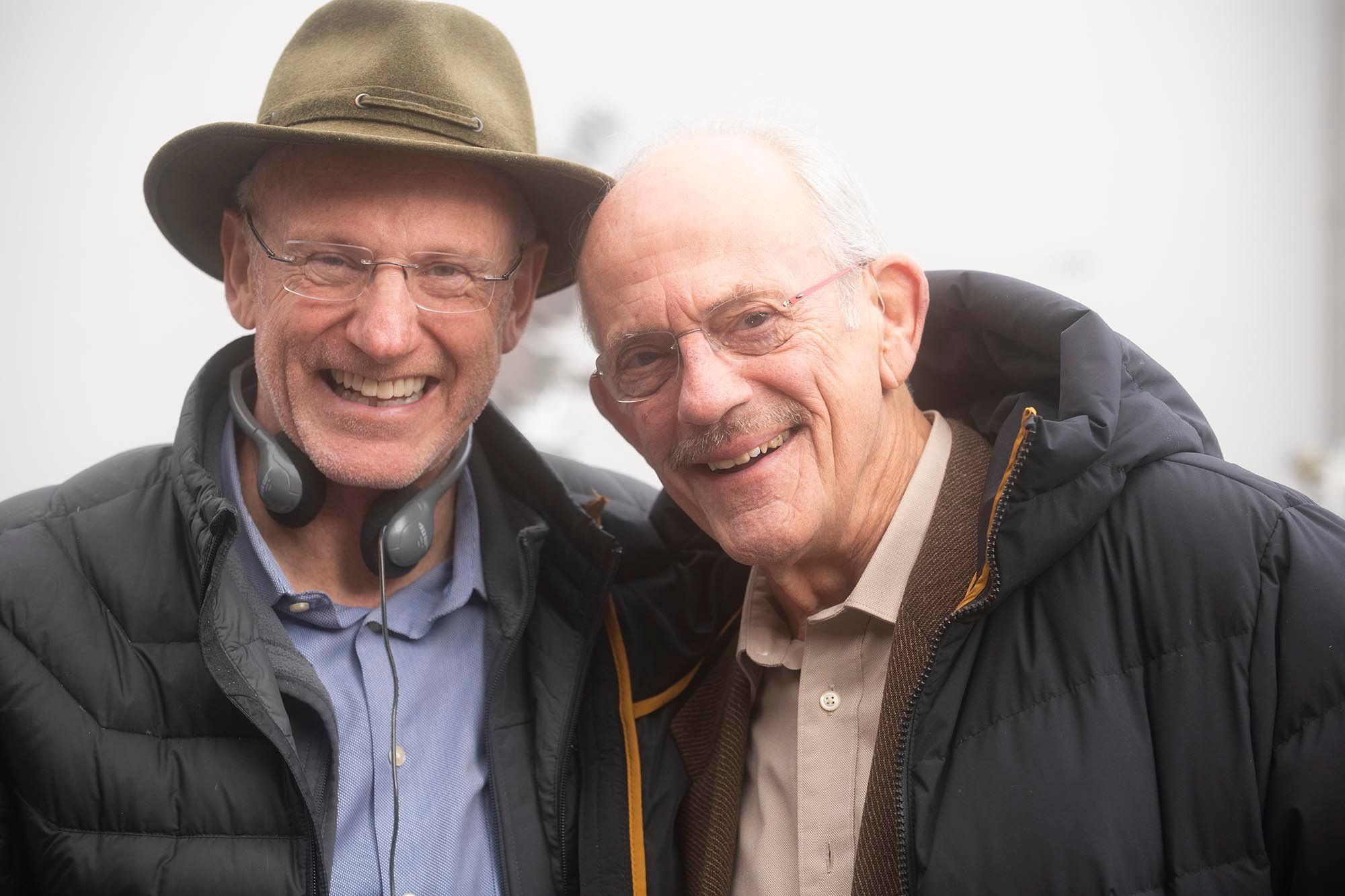
The cast is another highlight of the film, really elevating the whole affair. With Hollywood veterans in the mix, it felt fair to inquire what it was like directing such experienced talent. “This isn’t my first movie, so I’m used to working with strong actors. But here’s the thing. Actors will always listen if you can answer their questions. They want to know why their character is doing something and whether it fits their arc. If you have a vision, they’ll trust you.” On Lloyd in particular: “A legend. What a pleasure to work with.”
While Guns & Moses operates as an entertaining 90-minute flick that can be taken at face value, Sal doesn’t shy away from social and political messaging, making his stance clear. “We watched thrillers six nights a week. My wife and I sat down every night and worked our way from Hitchcock forward. It’s my favorite genre. Then the shooting in Poway happened,” he said, referring to the 2019 California synagogue attack. “I met with Rabbi Goldstein of that congregation, who had lost a finger, and he spoke about spreading mitzvot [good deeds] in memory of the woman who was killed. That’s when I knew what this movie had to be.”
The movie doesn’t shy away from confronting antisemitism head-on. Its villains include neo-Nazis, and Litvak doesn’t see that as a stretch. “Even before October 7th, I was involved with Magen Am,” he shared. “It’s a group that trains regular Jews like me to defend themselves. Law enforcement professionals who saw the film told me they loved the scene where Rabbi Mo learns to shoot, because the terminology we used was real. That’s how someone actually learns to use a firearm. You can’t just pick up a gun and be good in a pressure situation. You need serious training.”
One powerful moment in the film comes when Rabbi Mo realizes the suspect can’t be the killer because of a quiet, human moment they shared with a Holocaust survivor. To Sal, this is the ethos of much of the story. “Most people now hate each other because they’ve never actually been in a room together.”
The film even takes a bold step by letting a neo-Nazi character evolve. Without spoiling too much, we asked Litvak about the arc between the bigot and his father. “It’s not about making the villain sympathetic. It’s about asking: what happens when people are confronted with real stakes, with real people? You might think you hate Jews, but you’ve never talked to one. Until now.”
We couldn’t interview Litvak without addressing his sizable social media presence, with hundreds of thousands of followers on Instagram and over a million on his Facebook page, Accidental Talmudist. How had his work as an online creator shaped his feature-length work? “I’m a communicator,” he said. “At first, I didn’t want to do short-form content. To me, a video meant a crew. A script. A shoot. If it’s not that, what even is it?” Eventually, though, he adapted. “Around the same time I was posting Civil War content from one of my previous movies, Saving Lincoln, on Facebook, I started sharing Jewish jokes. That turned into videos. And then the audience grew.”
He’s even turned those jokes into a book, Let My People Laugh: Greatest Jewish Jokes of All Time! “There are a ton of Jewish joke books out there, but most of them aren’t funny. Mine are short and actually make you laugh. My father loved telling jokes — and so do I. That’s a big part of who I am.”
Litvak shared insights about his current lifestyle, which involves giving a daily Talmud lecture live on Facebook to a global audience. “As I got more religious, I wanted to learn Gemara. But I was scared. I didn’t know if I was even allowed to study it… maybe it was like Kabbalah, reserved for rabbis. But I went into a Judaica store, picked up the first Artscroll volume of Tractate Berachos, and when I brought it to the register, the guy asked, ‘You starting Daf Yomi?’ Turns out it was Day 1 of the cycle. I felt like Hashem handed it to me.”
Guns & Moses is a passion project that has faced setbacks, like a Hollywood exec telling Sal the film should go to streaming because “Christians and conservatives won’t like this, they hate Jews.” Litvak remained confident and adamant about securing a theatrical release. “I told that suit that he’s wrong about our audience! A lot of the regular viewers of my classes are Christians. They love Jews and are certainly open to learning.”
The film has cult classic potential. It doesn’t dilute its identity to appeal to the mainstream, but instead embraces the specificity of its world and trusts the audience to keep up. For Litvak, authenticity isn’t an aesthetic choice; it’s the point. The result is a well-executed movie that feels personal, purposeful, and proudly unlike anything else out there.
Find tickets to Guns & Moses and more information HERE.
 TV and City