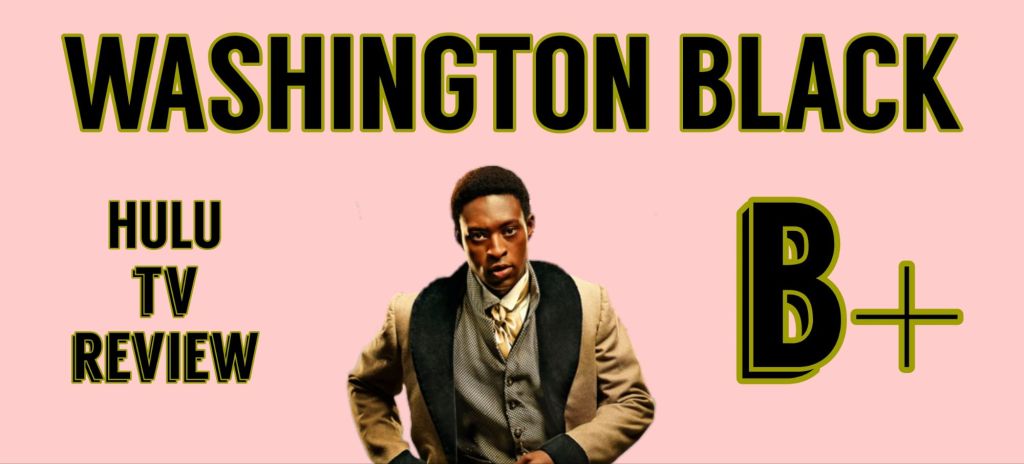
All episodes of Washington Black are now streaming on Hulu.
By Greg Wheeler
Hulu’s Washington Black is, at its core, a sweeping tale of flight. Not just the literal kind involving balloons and flying machines, but the emotional and spiritual kind too. Spanning continents, decades, and identities, the eight-episode miniseries offers a panoramic coming-of-age story shaped by slavery, science, romance, and the relentless pursuit of freedom. While the adaptation doesn’t quite reach the literary heights of Esi Edugyan’s celebrated novel, it stays afloat thanks to moving performances, thoughtful direction, and a powerful central message.
At the center of the story is George Washington Black, portrayed with deep sensitivity by Ernest Kingsley Jr. We first meet him in flashbacks as an enslaved boy on a brutal Barbados plantation. His life changes when he becomes the unlikely apprentice to Christopher “Titch” Wilde, a scientist and abolitionist who arrives with a flying machine and a complicated relationship with power. Their journey together, by airship, pirate ship, and eventually across the Arctic, becomes a winding path of self-discovery, invention, and heartbreak.
In the present-day storyline, Wash is living in Halifax under the alias “Jack Crawford,” haunted by his past while quietly working on his own inventions. The show cleverly alternates between timelines, using memories not just to fill in gaps but to deepen our understanding of how Wash became the person he is. Whether he’s navigating trauma, longing, or the rare chance for connection, especially through his budding relationship with fellow outcast Tanna Goff, Wash remains a compelling and grounded protagonist.
The show’s early episodes are particularly strong. They blend the poetic with the painful, painting Wash’s world in rich cinematography and emotional depth. The first few chapters highlight the show’s central questions: What does freedom really look like? Who has the right to dream? And how do you build a future when history has tried to define your past?
Later episodes lean more heavily on plot, adding kidnappings, false identities, romantic tensions, and a globe-hopping finale that touches down in Morocco, London, and Dahomey. Some threads, such as the bounty hunter Billard or the emotionally distant Wilde patriarch, verge on melodrama or become repetitive. Still, the core emotional story remains intact. Wash is looking for answers, from Titch, who both saved and abandoned him, from Kit, the woman he learns was his mother, and from himself as he tries to define his place in the world.
One of the show’s most affecting themes is its focus on legacy and mentorship. Wash is shaped not just by those who rescued or raised him, but also by people who challenged him to grow. Characters like Barrington, the freedom-fighting pirate, Angie, the sharp-witted café owner, and Medwin, whose personal guilt mirrors Wash’s need for clarity, all provide meaningful emotional weight to his journey.
Stylistically, Washington Black is often beautiful to look at. From the golden heat of the Caribbean to the stark blues of the Arctic, each location feels specific and lived-in. The score is emotionally resonant without being overbearing. While some of the visual effects feel a bit undercooked, particularly during scenes with Wash’s inventions, the overall production values are high and consistent.
The romance between Wash and Tanna gradually becomes the emotional heart of the show. Though it starts with caution, their partnership, both scientific and romantic, adds warmth and grounding to the broader adventure. By the end, they succeed where Titch could not. Together, they build a working flying machine and begin a new chapter, not as fugitives or apprentices, but as equals.
If there’s a flaw to point out, it’s that the series can sometimes over-explain itself. Long monologues and dialogue-heavy exposition occasionally slow things down. A few mid-season episodes blur together, weighed down by the effort of covering so much ground. These are the natural growing pains of adapting an ambitious novel into a tight TV structure.
Still, Washington Black earns its final emotional payoff. This is a story about survival, but also about healing. It is about invention and escape, yes, but even more about building a future with purpose. Wash’s journey, full of loss and discovery, ends in a place of genuine hope.
I give Washington Black a B+.

 TV and City