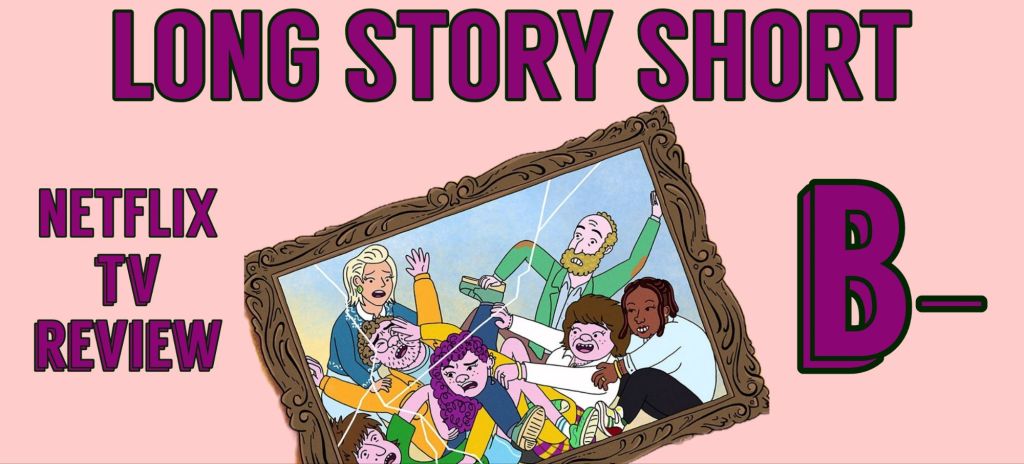
Long Story Short premiered on Netflix on August 22, 2025.
By Elazar Abrahams
As we approach the end of the year, I find myself with a large backlog of articles that still need to be written. See, I got married this September, and while 2025 has been incredible because of that, it also meant that TV and City took a backseat. That’s valid, but there’s so much great entertainment out there that deserves to be shared with our readers. On top of that, I also accepted screeners and press tickets for a number of projects. Those perks come with the expectation that this site will be covering them, and I feel quite bad about that. Many of the shows and movies have long since premiered, and the theatrical productions closed as scheduled. Still, it feels only right to sit down, put pen to paper (or keyboard to screen, rather) and get these pieces out into the world. May 2026 bring more great times and excuses, and more good art into all our lives.
One of the first television reviews I fell behind on was that of Long Story Short, which is a shame because it was one of my most anticipated premieres of the year.
Creator Raphael Bob-Waksberg has earned the benefit of the doubt. After all, his opus BoJack Horseman did not exactly arrive as a fully formed masterpiece in its first season, and then it went on to become one of the greatest animated shows of all time, with a depth that would have sounded unthinkable to someone who bailed after a few early episodes.
That context matters with Netflix’s Long Story Short, Bob-Waksberg’s new animated series about a family whose lives we keep revisiting across different time periods, bouncing from childhood to adulthood and back again. I finished the season feeling both optimistic and annoyed at myself for not having a cleaner opinion.
I’m giving it a B-, and I’m conflicted about that grade. On one hand, it feels like I might be being too generous because the show did not hook me like I wanted it to. At the same time, I don’t want to undersell what it’s doing well, because by the back half, the series starts to make a stronger case for itself.
The first hurdle is the structure. Time-jumping storytelling is a great trick when it adds meaning, contrast, or emotional punch. Early on, Long Story Short is still figuring out what it wants the trick to accomplish. The jumps can feel like a gimmick before they feel like a narrative language. It took me a while to adjust to the show’s rhythm and to understand what kind of story it wants to tell by cutting across decades.
But it does eventually start making sense. The more you spend time with this family, the more the time hops start to feel purposeful, especially once you’ve seen enough of the characters in enough phases of life to recognize patterns. The show begins to find that bittersweet sweet spot where the comedy is not just “jokes,” but the humor of watching people become themselves, and then watching them try to escape themselves.
That said, I wish it was funnier across the board. That’s probably my biggest complaint. The show has moments of sharpness and some great observational beats, but there are also stretches where it feels more like a warm dramedy than a comedy. When an animated show is built around this much talking and this many interpersonal scenes, the laughs matter. Even BoJack, in its messier early days, had a stronger comedic engine.
Where Long Story Short really won me over was in the later episodes, which are easily the strongest part of the season. Once the series gets more confident about what it is, the emotional arcs feel clearer, the format feels less showy and more useful, and the characters start to accumulate the kind of specificity that makes you want to keep hanging out with them.
Also, the Jewish content here is pretty fantastic. It’s not just surface-level “Oh, they’re Jewish” decoration. It’s woven into the family texture in a way that feels needed. Episode 8 is a highlight in particular, the moment where the show feels most locked in and most comfortable being itself.
It’s also worth noting that Long Story Short is very different from BoJack Horseman. You are not getting the same Hollywood satire, not the same tone, not the same brand of existential dread. But you can absolutely see the same creative mind behind it. There’s a familiar interest in neuroses, and in the ways people narrate their own lives and then get trapped by the narration.
Long Story Short shows a lot of promise, and even though its freshman outing was a letdown, I will be watching season two.
I give Long Story Short a B-.
 TV and City