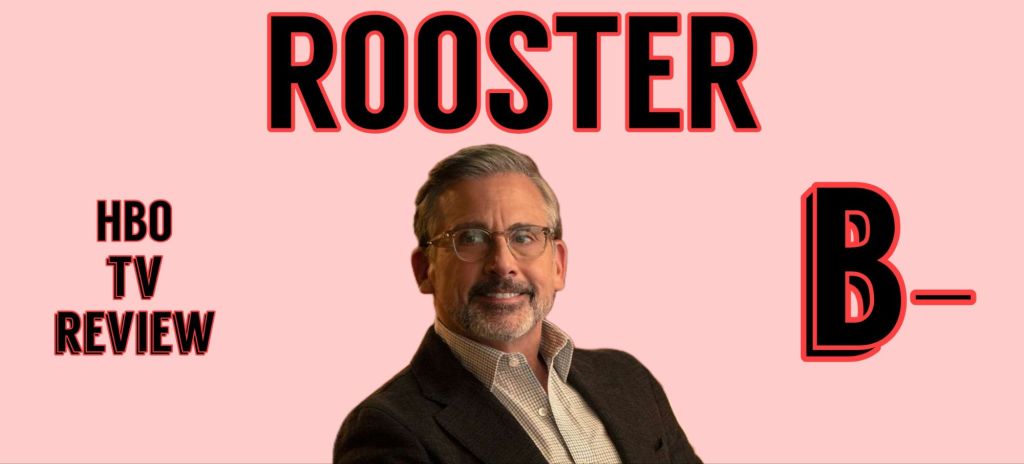
Rooster premieres March 8 on HBO Max.
By Elazar Abrahams
Bill Lawrence, creator of such sitcoms as Scrubs and Ted Lasso, is one of the most reliable TV hitmakers of the last two decades. As such, any new project of his carries high expectations. Especially Rooster, his new HBO comedy that stars Steve Carell, himself one of the most recognizable comedic leads of the 21st century. Here, Carell plays Greg Russo, a famous author who winds up teaching at a college while trying to mend a complicated relationship with his daughter, who also teaches on campus.
One can’t accuse the show of being bad. It’s not. It’s competent, confident, and occasionally very funny. It has the expected wholesome warmth running through it, and the characters are people you want to watch hang out together. But for a comedy with this pedigree attached, it is surprisingly hard to get sucked in.
The core issue is character definition. Based on the first six episodes, Greg still feels like a sketch of a person rather than a full one. He wants a relationship with his daughter, he wants to fix what’s broken, and he’s trying to prove he’s not just a self-involved public figure who dropped the ball. That’s a workable start, but it’s also basically the only thing we know about him. Carell does what he can with it, but there’s a limit to how far charm can carry a character who hasn’t been given enough dimension.
The supporting ensemble has a similar problem. The show keeps putting people in scenes together, and you can sense the writers trying to teach you who these characters are through little quirks and bits of banter. As the season progresses, that starts to work more, mostly because you get used to the rhythm and begin to recognize the show’s DNA. But unfortunately it feels like Rooster is operating one gear below where it should be. The ingredients are there but the flavor isn’t.
Occasionally, there will be shenanigans that make up for the flaws, like when Greg ends up at a frat party, and it’s the kind of sitcom-y situation that plays to Carell’s strengths. It’s broad and it finally gives the show excitement beyond quiet conversations about everyone’s feelings. If Rooster had more episodes that looked like that, the season would be in a much stronger place.
Another highlight is Phil Dunster (Jamie Tartt himself), who shows up as an asshole-ish presence, but in a notably different flavor than his Ted Lasso character. That was a really fun casting choice.
I wouldn’t write Rooster off just yet. There are definitely funny moments, and by episode six the show is starting to feel steadier, like the writers are learning what’s working and leaning into it. It’s also possible that this is one of those seasons that looks better in hindsight once later years pay off the groundwork. But as of now, Rooster feels like a comedy made by very talented people that hasn’t quite found the thing that makes it pop.
I give Rooster a B-.

 TV and City