Antigone (This Play I Read in High School) began performances at the Public Theater on February 26 and has been extended through Sunday, April 5.
By Noam Abrahams
After a politically updated Oedipus wowed critics and audiences on Broadway this season, it’s perhaps fitting that a “modernized” version of its sequel, Sophocles’ Antigone, has popped up elsewhere in the city. In Anna Ziegler’s Antigone (This Play I Read In High School), this refresh of the Greek tragedy takes place in two main ways: through Antigone’s driving motivation and through the play’s main framing device.
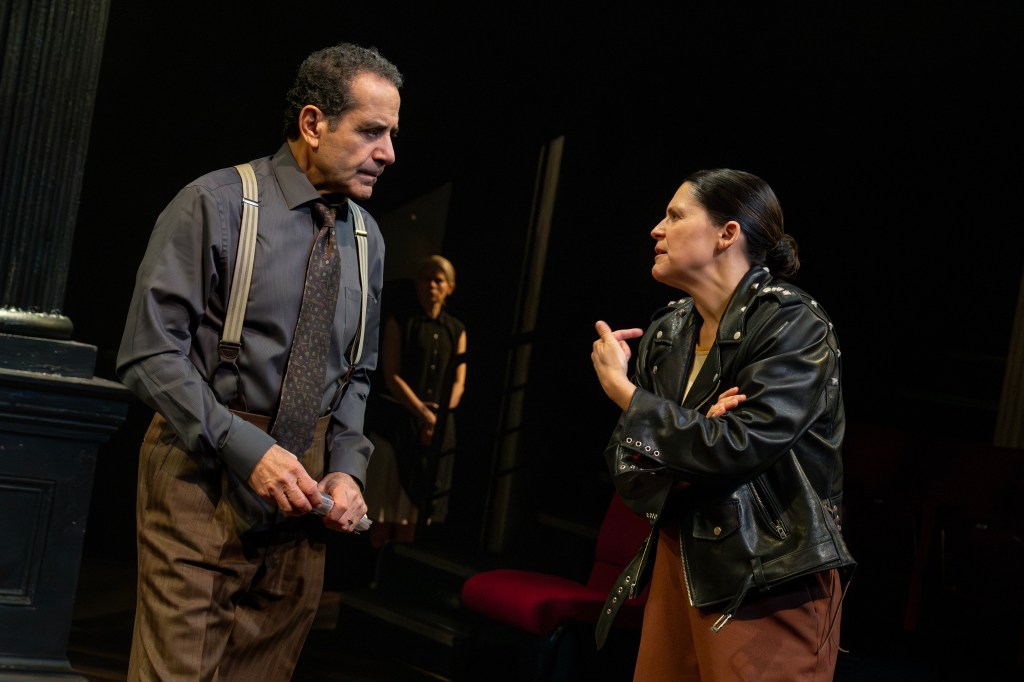
In the original Antigone, Creon attempts to consolidate power by forbidding Antigone from burying her brother Polynices, who died a traitor. Antigone refuses to obey this unjust edict, speaking her mind and following her conscience even though it will lead to her death. Ziegler taps into an issue that mirrors the moral complexity of this by changing the law that Antigone is defying. This Antigone (Susannah Perkins), a scrappy free spirit in a leather jacket and Doc Martens, had sex with her fiancé, Haemon (Calvin Leon Smith) – Creon’s son – and has become pregnant. Bad news: Creon (Tony Shalhoub) has re-enacted harsh anti-abortion laws, which force her to seek help at a shady back-alley clinic. Sure, the change does make the nature of the conflict different, but the story retains its weight largely because of the performances at its center.
This is mostly due to stellar turns by Susannah Perkins as Antigone and Tony Shalhoub as Creon. (Calvin Leon Smith’s Haemon and Haley Wong’s Ismene are excellent too, but have way too little stage time to be notable.) Perkins’ heroine is compelling and magnetically intense, messy and scrappy, and guides the play through its tensest moments. Shalhoub also stands out as Creon, tormented but unrelenting in his decisions. Unfortunately, most of the time they spend opposite each other is eaten up by characters who add nothing to the story – three cops who speak one word at a time in heavy Boston accents, a palace guard who spends half his stage time dropping his papers on the floor, and the play’s narrator.
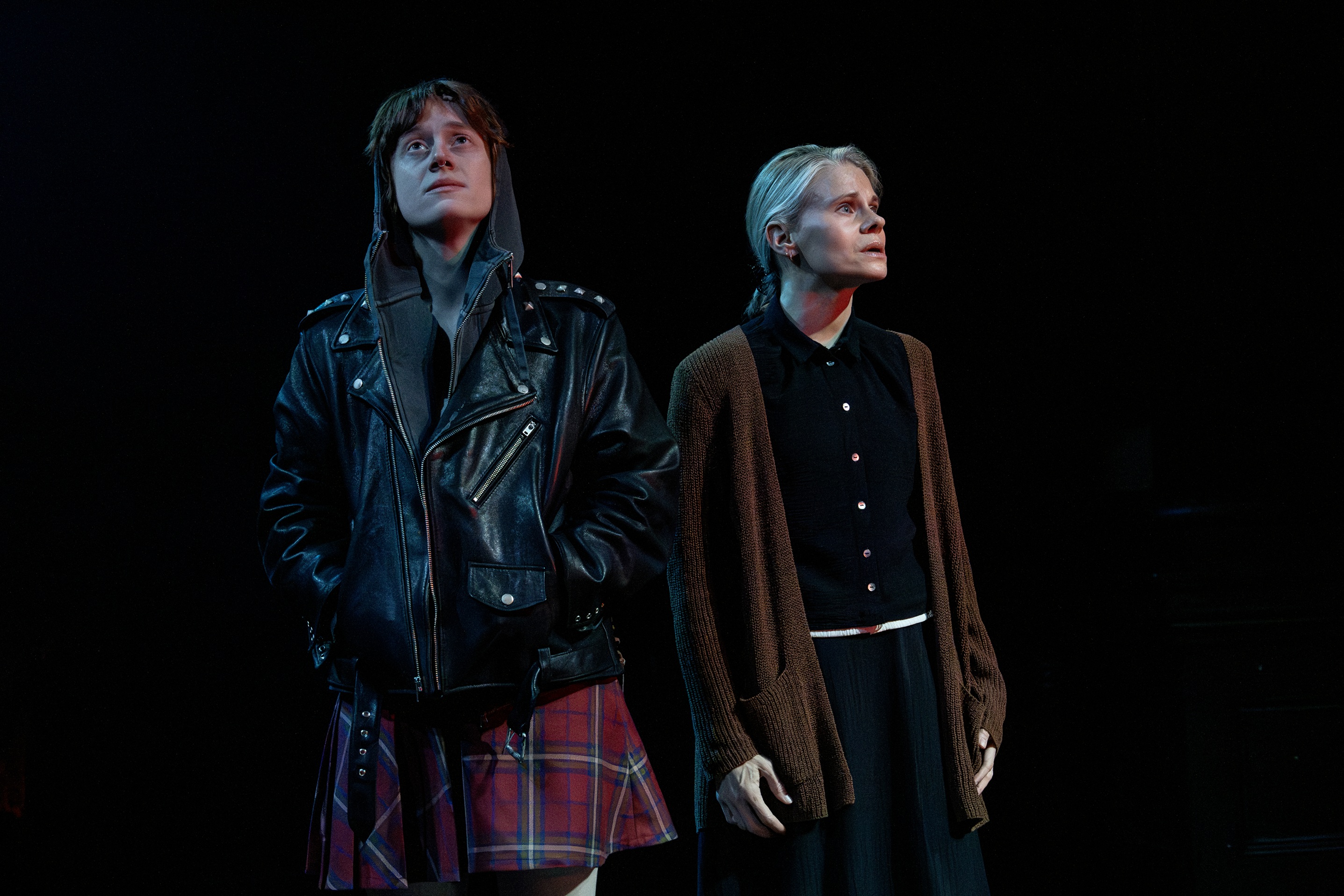
That narration is where the play falls flattest – with its transformation of the Greek chorus into a single narrator: Dicey, played by Celia Keenan-Bolger. Unlike the traditional Greek chorus, which contextualizes the plot, Dicey puts her own story first and has the subtlety of a sledgehammer. Dicey is a middle-aged woman reflecting on the impact reading Antigone had on her life as a teenager. She recounts the story to the audience while connecting it to her own anxieties about motherhood and personal agency. In theory, she aims to deepen the play’s emotional connection, but ultimately does the opposite. The narration feels like it interrupts the play’s momentum far more often than it adds, even misremembering the fate of Oedipus during her “Antigone 101” intro.
Antigone (This Play I Read in High School) has a lot of flaws. It’s sometimes self-serious, sometimes laughable, sometimes over-ambitious, and sometimes over-literal. But for everything going against it, standout performances for Perkins and Shalhoub let the play stand on its own. I only hope the play manages to find the sharp, gripping tragedy buried underneath itself as it develops.
Find tickets and more information HERE.
 TV and City