By DC Bolling
Many filmmakers have made a name for themselves in the current 21st century. But there’s one that has always stood out as possibly THE best according to hardcore film fans and in Hollywood: Christopher Nolan. Apart from Steven Spielberg, Nolan is my second favorite director working today. Why? For over two decades, he’s been an outstanding writer, director, and producer (together with his wife, Emma Thomas) who knows how to make his viewers think and be engaged with each project he takes on one after the other. Starting from smaller indies to graduating from top-tier, complex blockbusters, a man of his talent plays by his rules in always shooting on film over digital and will do practical effects over CGI, even with an expensive budget. He knows how to bounce around and not make the same film, ranging from comic book movies, sci-fi mind-benders, or period dramas that leave us guessing what’s next.
Since the beginning of his Batman trilogy, practically everything he does feels like a theatrical event that we aren’t always prepared for, and it forces us to use our brainpower, thinking about those two and a half hours worth of time and digesting them more than twice. Not only does his name sell tickets when he releases something new, but they must also see it in every IMAX format accessible within a reasonable distance.
So, with the coming smash hit of The Odyssey this summer, it is the best time to rank all of Christopher Nolan’s films in a new series called Director’s Canvas, where I take the filmography of a particular director and see where they land. After I ranked all of Spielberg’s films (at the time) a few years ago, this was a series I thought about doing a while after, except I needed the time and patience to watch and write about each movie. Since all of his movies are either outright masterpieces or passable, there isn’t one I particularly despise.
Let me entertain you without further ado by ranking all 12 movies from the one and only Nolan.
12) Following
Release Date: April 3, 1999
Production Budget: $6,000
Domestic Box Office: $48,482/ Worldwide: $112,951
RT Score: 83%
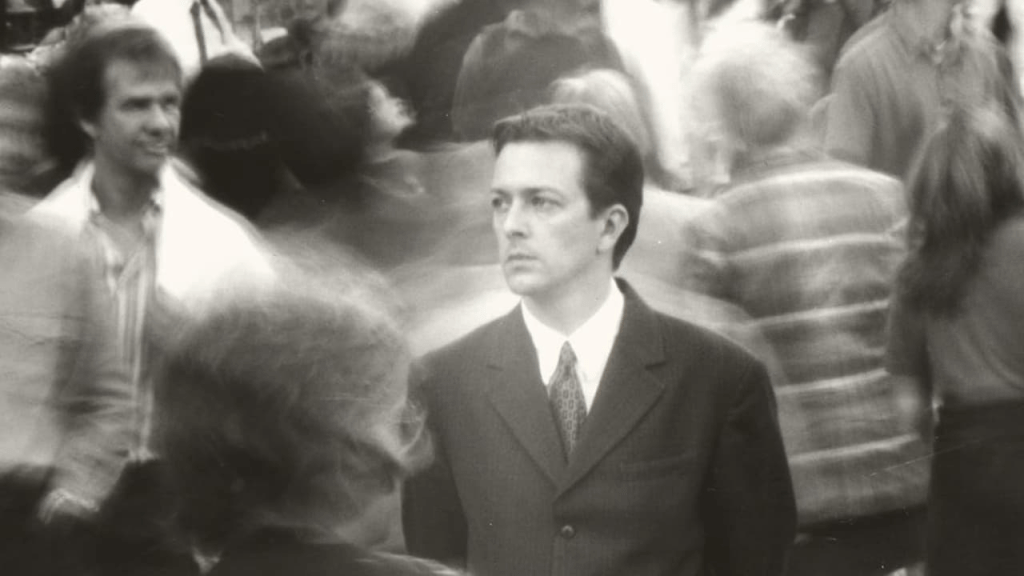
For his directorial debut, Following was the last film from Nolan I hadn’t seen back in 2020. And seeing what he would’ve done later in his career, this is the definition of a low-budget, independent thriller that almost differs from what we associate now with the filmmaker. This follows a man (Jeremy Theobald), a writer of sorts, fascinated by following strangers around the streets of London. He’s not a killer; he’s curious about their everyday lives. Once Cobb (Alex Haw) notices the young man, he takes it further, breaking into people’s houses. Usually a blind spot in his filmography, but if you had no clue Nolan was behind this, it still works as a black-and-white noir that will have us question the people we see in life, wondering what makes them who they are and what secrets they must be hiding.
Like his next film, Memento, his earliest work plays with the narrative I didn’t get at first, but I quickly understood it more when it continued channeling his inner Hitchcock. And under a budget of $6,000, it’s pretty impressive to see Nolan craft a film with only a few actors he knew and shot on the weekends, taking the production a year to complete. Watching Following proves wisely it can be inventive while in Jeremy Theobald’s shoes when this obsession goes over his head. At only 70 minutes, the overall investment of the story is short to find it completely captivating, and the climax didn’t hit as strongly despite the inevitable twist. But though it’s imperfect, it showed signs of Nolan’s greatness when getting viewers or fans who have yet to stumble upon his debut to be intrigued with what he made here.
11) Tenet
Release Date: September 3, 2020
Production Budget: $205 Million
Domestic Box Office: $58.5 Million/ Worldwide: $365.3 Million
RT Score: 69%
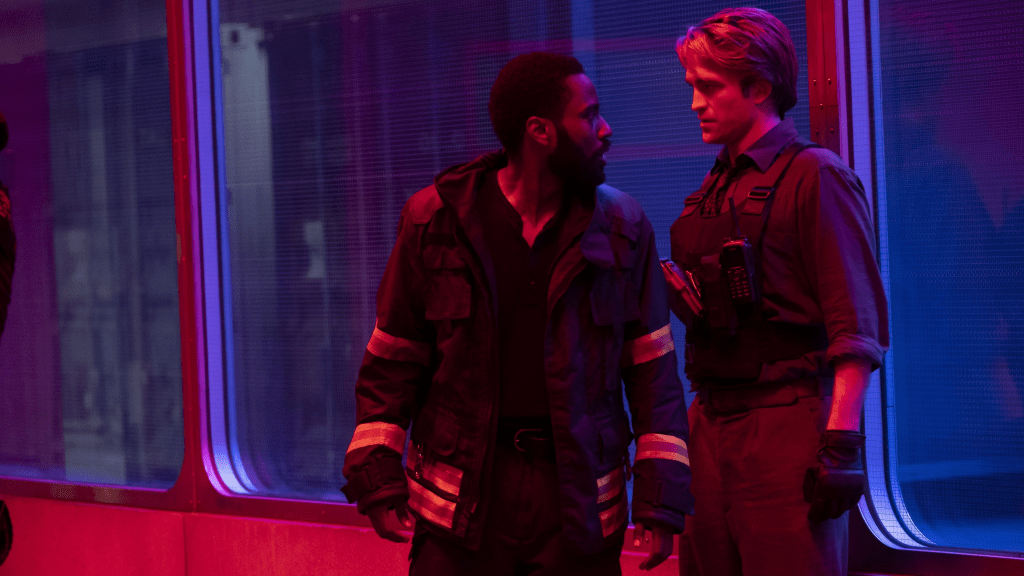
Three years after its release, Tenet might’ve been the one film from Nolan I had difficulty remembering. This was the first huge blockbuster released during the pandemic and was only the second movie I watched in theaters since lockdown started. Finally, after finding the time to give it a second viewing, I realized this 2020 sci-fi espionage doesn’t aim to be simple, yet it can be too complex and ambitious for its own good. In another picture in which he works with the concept of time, we follow the Protagonist (John David Washington) on a quest to prevent a future attack on the globe, which involves an organization called “Tenet,” which allows him to travel backward in time.
Only someone like him could transform Tenet into something unlike anything we’ve seen before, challenging us more than ever. But it’s never become a favorite of mine since the story may become bogged down in its perplexity, even when staying focused a second time. Maybe it’s supposed to be a spiritual successor to Inception, but it’s challenging to keep track of what the characters are going through on their globetrotting trip, making it one of the most confusing movies I’ve seen in years. That said, the in-camera action certainly does the heavy lifting, as well as the stunning visuals and Ludwig Göransson’s score. And while there’s no emotional attachment to the main characters outside Elizabeth Debicki, John David Washington and Robert Pattinson’s performances are great, regardless. Also, it’s funny how I recently noticed they name-dropped J. Robert Oppenheimer, which would be the subject of his latest hit. Tenet gets by in its bold originality in tackling the realities of palindromes and paradoxes, but it never reaches the status of being great when the weak screenplay gets in the way.
FULL REVIEW—> RIGHT HERE
10) Insomnia
Release Date: May 24, 2002
Production Budget: $46 Million
Domestic Box Office: $67.3 Million/ Worldwide: $114 Million
RT Score: 92%
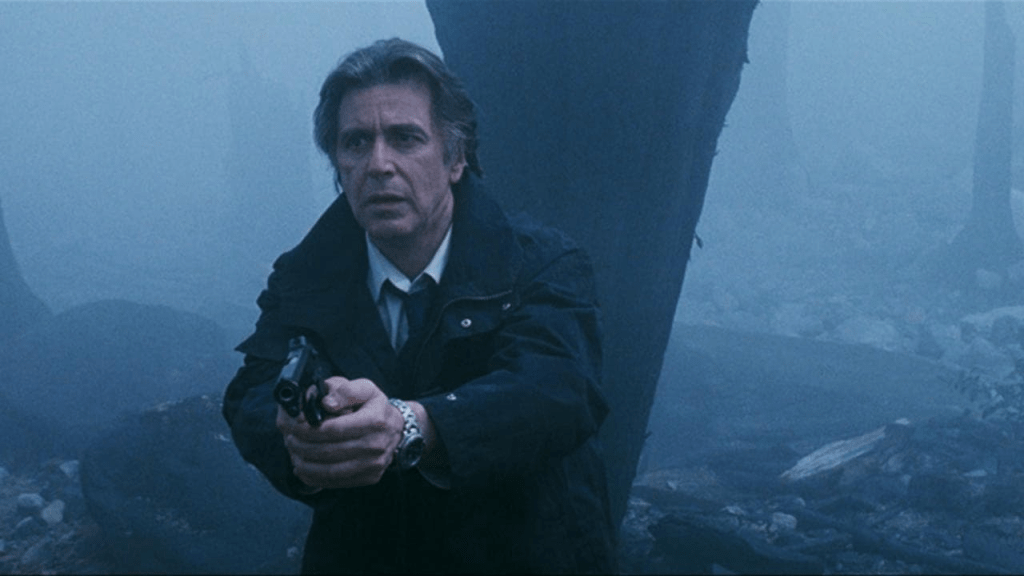
Some often cite Insomnia as Nolan’s worst film. But how could it be when it has three Academy Award-winning actors in one of the most overlooked thrillers of the 2000s? A remake of a 1998 Norwegian film he loved when he came to America, it follows L.A. homicide detectives Will Dormer (Al Pacino) and his partner investigating the murder of a 17-year-old girl in the small town of Nightmute, Alaska. Dormer’s time there gets more serious when he must hide the guilt of an accident he didn’t mean to do. It’s shocking how much Nolan’s third feature got better on another viewing, as the integral mystery hooked me more this time, including the backdrop of Nightmute that sees daylight during this time of year, which also has us feeling fatigued.
You get a very well-crafted film focusing less on the action and primarily on the personal journey of someone who might lose their mind. The intensity Nolen captured early in his career is unbelievable, especially the unforgettable chase on the beach in the fog. Pacino’s resume wasn’t the best of that decade, but as Dormer, he gives his most memorable performance where you feel what he’s going through despite his mistakes. He’s even better when he finally shares the screen with the late Robin Williams as Finch, one of two dark roles he pulled off in 2002 along with One Hour Photo. The calm demeanor to have us unsure if he’s the murderer or not doesn’t get old whenever he’s there. The ferry scene alone will have everyone thinking about the scene between Pacino and Robert De Niro Heat. Even Hilary Swank is great, too, despite being the weakest of the three. It’s not always perfect, but Insomnia is an underappreciated cast-and-mouse thriller led by two excellent performances in Pacino and Williams.
9) Interstellar
Release Date: November 7, 2014
Production Budget: $165 Million
Domestic Box Office: $188 Million/ Worldwide: $703.1 Million
RT Score: 73%
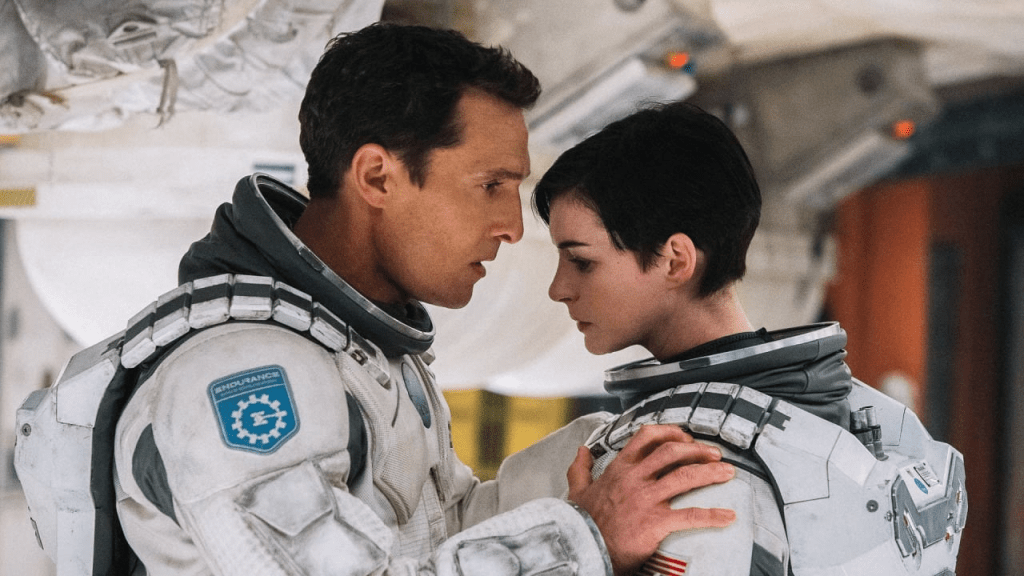
Amongst all of his films until this point, it seems Interstellar is the most polarizing nearly a decade after its release. Many have hailed it as a sci-fi masterpiece for its view of space exploration or a rare disappointment from the filmmaker. Truthfully, I loved it when I saw it in theaters. Watching it now, however, only sometimes captures the same experience, especially when you’re not viewing it on an IMAX screen. Still, I must admire Nolan’s ambition to make something visionary beyond belief this time. Earth is dying in the dystopian future, with limited support to come upon it as it’s running out of resources. The best way to figure out how to help is to travel across the galaxy through a wormhole in search of another planet to habitat, led by former test pilot Cooper (Matthew McConaughey).
Interstellar has a lot of things going for it to be admired. One of them comes from the visual effects. There are moments when they are in space that look so real after a while when they go through the various planets, and I can forget that this is an actual movie taking place. No wonder it took home the Oscar (though Dawn of the Planet of the Apes should’ve won). In his first film after winning Best Actor, McConaughey is fantastic as Cooper, a father who wants a change for the future and takes the chance to save humanity and leave his family and everyone back on earth to protect them. The film’s heart comes from the relationship between Coop and his daughter, Murph, early on. However, Jessica Chastain’s intricate performance of the adult Murph is one of her most underappreciated roles outside McConaughey. As they are now the same age, Cooper watching Murph’s video message is one of his movies’ heartbreaking scenes.
Though the film isn’t perfect, which stems from issues, the screenplay from Nolan and his brother Jonathan can feel cluttered in how it conveyed the story in parts, leaving some obvious foreshadowing in the mix. Some moments were confusing, maybe because I didn’t understand science exposition despite the praise from real-life physicists. And with it nearing the three-hour mark, it shouldn’t have been that long. The underlying message of it all is that there is an existence in how our lives are conducted, and everything must be learned and acknowledged at some point in the present. Although it’s not one of Nolan’s best films, there are so many exciting ideas to consider that it’s a pleasant and straightforward comparison to the iconic 2001: A Space Odyssey. Interstellar is flawed in some spots, but those glimpses of Nolan’s touch of greatness are always present. It gets a little confusing, and the final ten minutes left me cold, but it’s a solid, ambitious space epic fans will consider an all-time experience.
8) The Prestige
Release Date: October 20, 2006
Production Budget: $40 Million
Domestic Box Office: $53 Million/ Worldwide: $110 Million
RT Score: 77%
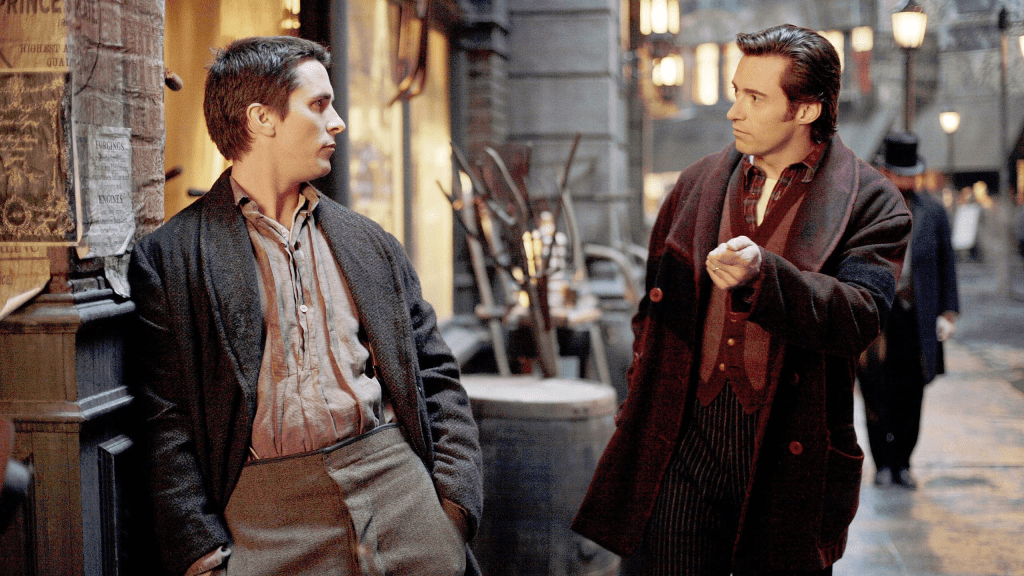
It goes without saying that The Prestige made more of an impression than Neil Burger’s The Illusionist in a year where we witnessed two-period dramas about magicians. And even knowing how it ends, you can’t help but find it stunning as someone who enjoys dissecting magic. Hugh Jackman and Christian Bale play Robert Angier and Alfred Borden, two-stage magicians in 19th century London who become rivals after a tragic accident drifted them apart. Since then, both sabotage their acts and become obsessed with how each of them pulled any successful trick. Nolan’s adaptation of Christopher Priest’s novel will have you thinking after it ends, and though it’ll take more viewing to love The Prestige fully, knowing Nolan possibly made the film like the three-act structure Michael Caine’s John Cutter talked about in the opening and close is mind-blowing: The Pledge, The Turn, and the Prestige. We’re watching two men who will go to great lengths to outdo one, even if it means dealing with deadly consequences in their personal lives. The idea of obsession draws us in with how it can’t all be worth it, and in this case, mastering the art of magic is tricky. Sometimes, the story can be confusing with the back-and-forth narrative (with Robert and Alfred reading each other’s journals), but it all makes sense with one hell of an ending.
Jackman and Bale gave the most underrated performances of their careers, with the former always having me realize he’s an incredible actor outside of playing Wolverine. And the rest of the ensemble doesn’t get enough attention in Nolan’s filmography when it has Caine, Scarlett Johansson, Rebecca Hall, Andy Serkis, and David freakin’ Bowie (R.I.P.) as Nikola Tesla. Over time, this definitely grows on fans, including me, similar to other films, despite some pacing issues. The best compliment is I stopped seeing the actors and saw them as if they were real characters. It performed modestly well at the box office and with critics, earning two Oscar nominations for Cinematography and Art Direction. But The Prestige stays with you with how Nolan pulled off a layered and atmospheric drama they will have us looking closely.
7) The Dark Knight Rises
Release Date: July 20, 2012
Production Budget: $250 Million
Domestic Box Office: $448.1 Million/ Worldwide: $1.081 Billion
RT Score: 87%
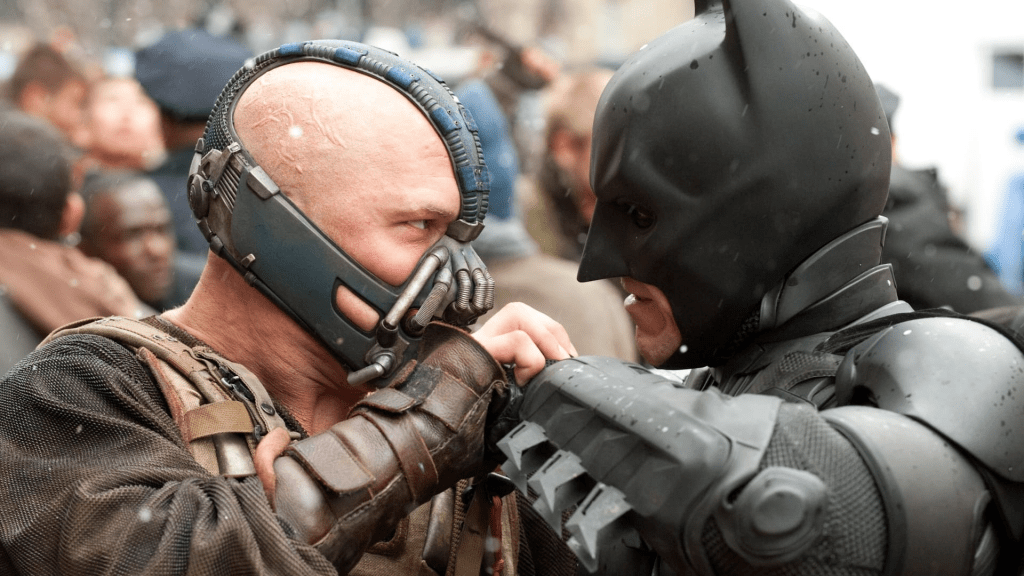
Everything must end eventually, so it had to be impossible for Nolan to wrap up his Batman trilogy properly. The Dark Knight Rises is an effective and exhilarating third chapter that doesn’t imitate what the previous one did, notably with its tone. Although following The Dark Knight is challenging, that will always be true. Eight years after disappearing from the light, Batman and Bruce Wayne recluse themselves after taking the blame for Harvey Dent’s death. But a new face of evil arrives in Gotham with mercenary Bane (Tom Hardy), who plans to take over the city Batman once protected. The hype was real for what was my most anticipated movie of 2012 when I attended my only midnight screening with my sister and her friends. And my reaction towards this a decade later stayed the same when this is almost everything you could ask for to conclude a trilogy.
The Dark Knight Rises deals with more significant stakes this time once Bane turns Gotham into virtually a war zone, and Batman has to rise to the challenge to save his people. Even when Batman’s appearance might be the shortest of all three movies, it makes the rest of the time feel more compelling. From a thematic standpoint, you think Bruce’s pain and hope to overcome everything to become a true hero. Bale’s portrayal this time is broken emotionally and physically without losing his way through this role. But Tom Hardy gives his best performance of the menacing and formidable Bane, the most potent foe to defeat Batman. They took liberties with the character that probably wasn’t from the comics, but it worked based on Hardy’s physicality and way of words with a mask over his face. And he stood on his own without the mere mention of The Joker. The supporting cast also excels, from Anne Hathaway’s outstanding turn as Selina Kyle/Catwoman to Joseph Gordon Levett’s John Blake, who has such a great purpose to the story and doesn’t get enough credit.
But over time, everyone has grown to despise the movie by pointing out its countless flaws after its release, which will cause you to overthink the story. Is it faultless? No, but it irritates the hell out of me when people pick apart something that’s intended to be fun. You’re telling me you can’t like a film with a memorable fight between Batman and Bane? But it’s all in the investment with how everything came together to give fans some closure. To this day, it’s one of the most underrated superhero movies, and I think it holds up. The Dark Knight Rises is my least favorite of the three, but we got a satisfying end to a fantastic and vital comic book trilogy that gives the character the respect it deserves.
6) Oppenheimer
Release Date: July 22, 2023
Production Budget: $100 Million
Domestic Box Office: $325.1 Million/ Worldwide: $949 Million (as of 11/10)
RT Score: 93%
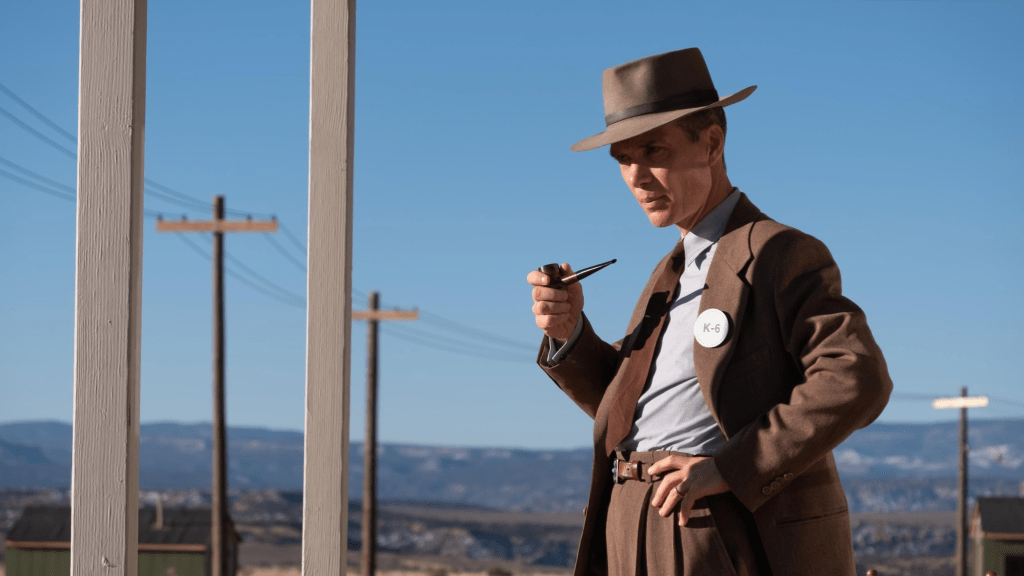
If non-history buffs weren’t aware of who J. Robert Oppenheimer was before this biopic, they certainly do now. For Nolan’s latest to be a three-hour epic drama about the father of the atomic bomb, the ending results are simply riveting shows he can’t miss. Out of his films post-Inception, Oppenheimer is most grounded in re-telling, stepping inside a beautiful mind to create something to change the world’s faith. Sometimes it’s hard to know what’s going down since my dumbass knows nothing about quantum physics. Even without reading “American Prometheus” and getting to know who he is, Nolan did his research to make this come true for a blockbuster that takes a step back from what he’s done before, almost enough to consider this his Social Network. If this was a final project in school, he passed with flying colors. We’re also given the best performance from the one and only Cillian Murphy as Oppenheimer, portraying the man as a genius and ambitious figure even without saying a lot but doesn’t yet realize his creation would be the start of how powerful this bomb could affect many worldwide. He also works with a tremendous ensemble that includes Emily Blunt, Robert Downey Jr., Matt Damon, and many others.
Dense without question, and yes, it’s Nolan’s slower-paced films, but it’s your fault for having no clue what you walked into. What I’ll never understand is those going into this expecting bombs going off every ten minutes so our minds wouldn’t wander off. That still doesn’t take away the achievement Oppenheimer shows off through its practical effects and tense nature leading up to dropping the bomb, which is why it was worth seeing in IMAX 70mm twice. It could land a spot in the top five with a few more watches. As it stands, Oppenheimer is one of the few films in 2023 that wasn’t a letdown, critically or financially.
FULL REVIEW—> RIGHT HERE
5) Dunkirk

Release Date: July 21, 2017
Production Budget: $100 Million
Domestic Box Office: $190 Million/ Worldwide: $528 Million
RT Score: 92%
There are two types of people in this world: Those who love Dunkirk and those who don’t. For me, it’s incredible how Nolan crafted a breathtaking WWII film. By that, I can’t agree with anyone who just doesn’t get it years later. With the Germans surrounding 400,000 soldiers on the British and French side, it’s all about the evacuation from Dunkirk told from three different perspectives: Land, sea, and air. The best way to view Dunkirk is not just as a war film but as a thriller that has us escaping the possibility of being captured or killed by the unseen enemy. And its use of tension-building throughout is merely adequate. And it’s the war picture focused on this brave evacuation because it’s a portion of British history that even the biggest geeks in culture are unaware of. Nolan utilizes familiar cliches and tries for the humanity of what ordinary people will do to save thousands of lives before it soon turns lethal. Sure, the biggest issue I and others endured was that the characters needed more growth to show who the main character was. Still, you want everyone to come home and live, including Tom Hardy, Mark Rylance, Cillian Murphy, and even Harry Styles, who didn’t do too badly in his feature debut. Dunkirk never lets up on the intensity from the first scene to the end, and it’s one of Nolan’s shortest films, clocking in at only 107 minutes.
Unlike Michael Bay’s over-the-top approach to the disastrous Pearl Harbor, his realistic depiction of everything showed his dedication to those who served but also showed the horrors of war. Also contributing to being a captivating experience is the sound design, cinematography, and one of the best Hans Zimmer Scores yet. Although people have lost interest in Dunkirk since its debut, I have maintained a love for it since the beginning, seeing it as an underappreciated masterpiece by Nolan and one of the best war movies of the decade. Becoming the highest-grossing WWII film until recently, it also won three well-deserved Oscars For Film Editing, Sound Mixing, and Sound Editing, as well as five additional nominations, including Best Picture and Best Director For Nolan (his first after being long overdue).
FULL REVIEW—> RIGHT HERE
4) Memento
Release Date: March 16, 2001
Production Budget: $9 Million
Domestic Box Office: $25.5 Million/ Worldwide: $40 Million
RT Score: 93%
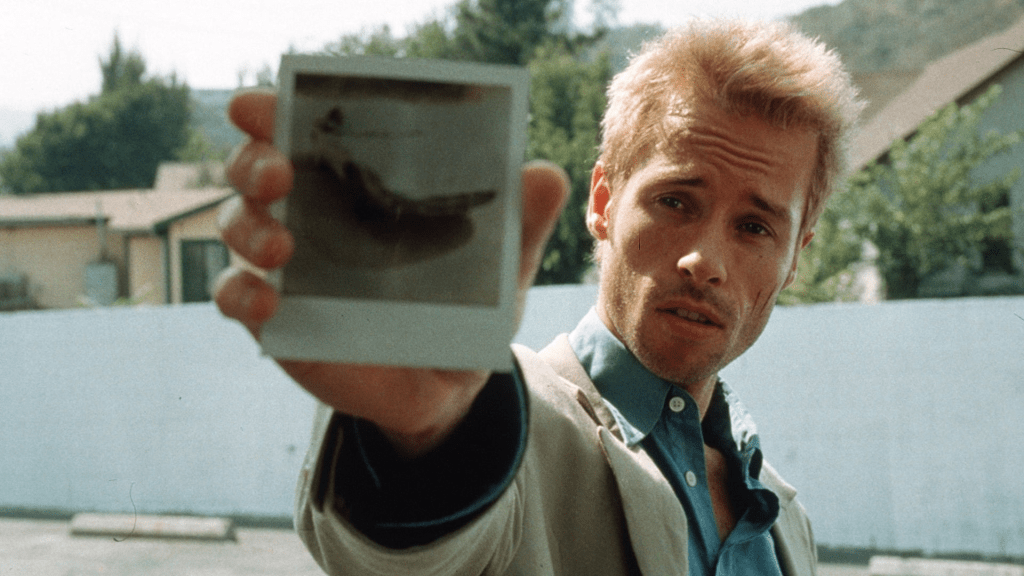
Remember when Hollywood honestly talked about remaking Memento? No? That’s because it’s an awful idea since you can never replicate one of the most original films ever. Based on a short story from his brother Jonathan, Nolan’s second feature film is a psychological thriller about Leonard Shelby (Guy Pierce), a former insurance investigator searching for the man who raped and murdered his wife. There’s a catch, though: He suffers from short-term memory loss (Anterograde amnesia), where he can’t form new memories. His most reliable sources are his tattoos and Polaroid pictures to help him remember. Some said this was their earliest introduction to Nolan, and they probably didn’t know what to think when Memento ended. The first time I watched it, it started confusing when putting the pieces together, only to learn halfway through that it had to be rewatched immediately.
We’ve seen films follow a non-linear storyline, but not since Pulp Fiction has it been done so imaginatively and without becoming a gimmick. The film uses black-and-white segments to tell the story chronologically and colorful sequences to fill in the blanks, placing us in Leonard’s point of view as he seeks retribution. Having us be like him to trace the steps will have us having this condition too, and I’m someone with a great memory, according to my family. As his breakout film, Memento led us down an unpredictable path to keep our eyes peeled on the screen on who to trust and looking at particular clues, having our minds blown once we reached the mid-point. Watching it the second time made me more hooked than before, all thanks to the swift editing that earned a well-earned Oscar nomination for Film Editing.
Guy Pierce gives his best performance to date as Leonard; he was an unknown at the time besides his role in L.A. Confidential. But he also worked great alongside Carrie-Anne Moss and Joe Pantoliano, respectively. Never as a neo-noir has been so clever under Nolan’s belt, which makes Memento a film best suited to going in blind to show someone who hasn’t seen it.
3) Batman Begins
Release Date: June 15, 2005
Production Budget: $150 Million
Domestic Box Office: $207 Million/ Worldwide: $373.7 Million
RT Score: 85%
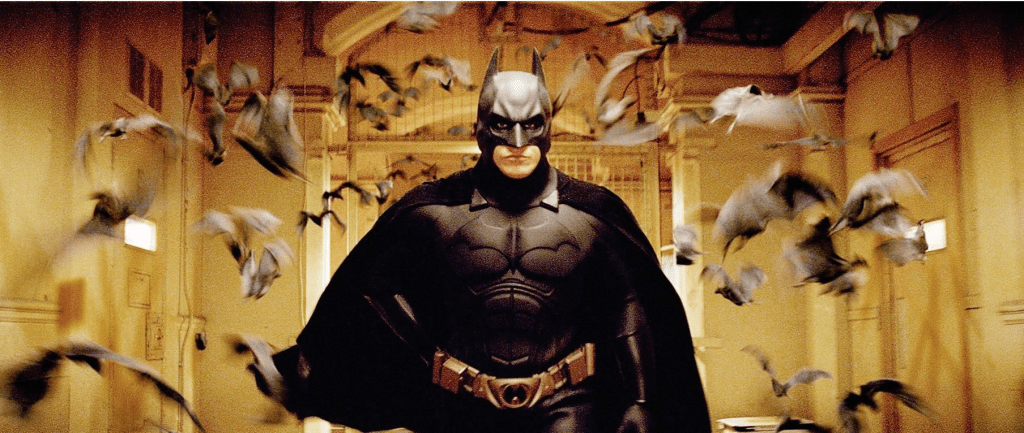
For us die-hard Batman fans, this was everything we could’ve asked for in a reboot. It was a franchise desperately needing to be loved on the silver screen after dealing with the late Joel Schumacher’s last two films (Batman Forever, Batman & Robin) that put a nail in the coffin for the Caped Crusader for a few years. And after a string of massive disappointments from DC Comics (Catwoman), Batman Begins was the boost we all needed. We see what Bruce Wayne (Christian Bale) went through when his parents were gunned down in front of him, providing the untold origin tale for the superhero that has yet to be depicted on screen. After leaving Gotham City to train with the League of Shadows under Ra’s al Ghul’s guidance, Bruce returned to warn those who stir up trouble and demand justice. Nolan was still an up-and-coming director three films prior, and his approach to making his Batman in a more dark, grounded reality builds this up to finally getting the character right since the acclaimed animated series.
It is rare to invest this much time in Bruce when it isn’t in his outfit, especially in the first hour. But it’s all in Christian Bale’s exceptional performance that lets the viewer get underneath the pain and strength to become Batman. Yet, of all the actors until that point, he was the first where I believed he could be the billionaire and a crime-fighting man dressed up as a bat. Even on subsequent viewings, I’ve found more appreciation for Cillian Murphy’s Jonathan Crane/Scarecrow than I did when I first watched this. The world Nolan sets up in the first installment is believable with no second thoughts, and you feel it through all the action that never stops you from losing interest. And besides Bale, you can’t hate Michael Caine’s Alfred with some solid comic relief or Gary Oldman, who continued to be an excellent James Gordon with each installment. How I missed this in theaters when I was nine will remain a mystery. The same goes for a few other blockbusters that same year. Batman Begins rightfully established Nolan’s name in Hollywood with an action-packed and almost emotional superhero flick that stands along with Star Trek and Casino Royale as the best reboots the 2000s offered.
2) Inception
Release Date: July 16, 2010
Production Budget: $160 Million
Domestic Box Office: $292.5 Million/ Worldwide: $837.1 Million
RT Score: 87%
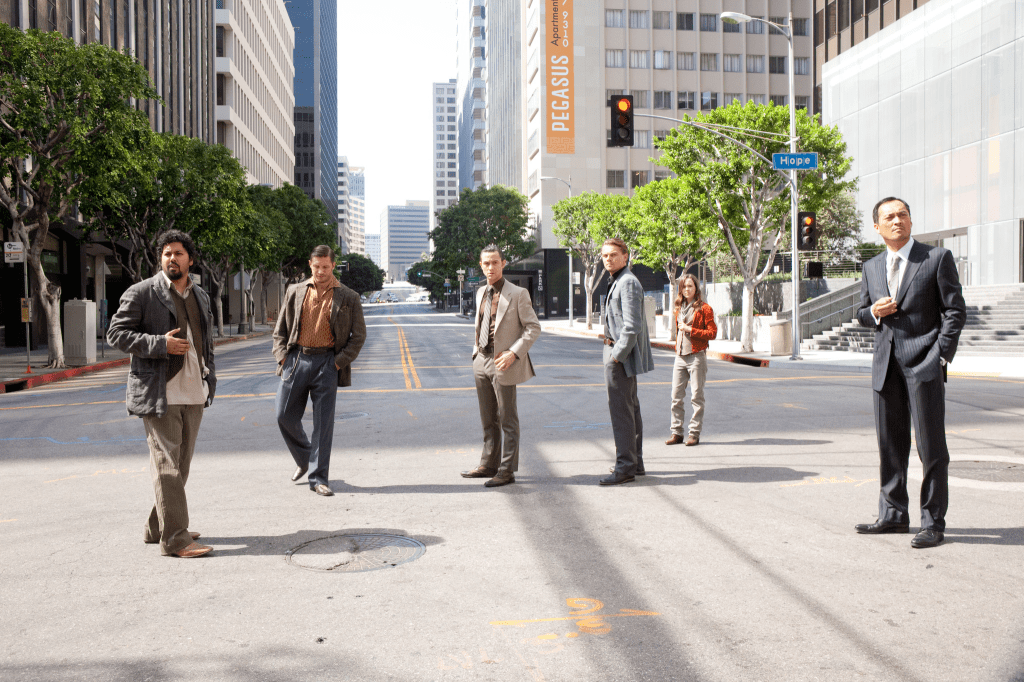
Sometimes, you must love original science fiction that exceeds all expectations. With Inception, it was a guarantee we’ll still be talking about exceptionally years after since it saved the summer of 2010. Nolan had this idea forever, and he’s always been fascinated with the concept of dreams. So why not make it a reality with a twist of an intriguing and complex heist? As someone who’s thought about and attempted lucid dreaming almost daily, it’s one of many reasons this is the thinking man’s blockbuster of its time. Here, we have Dom Cobb, an extractor who infiltrates other people’s dreams, stealing information from their subconscious. His chance to go home and see his children comes when he must perform an “Inception” on somebody, which is to plant an idea into them with the help of his team to accomplish it.
It always astounds me how Nolan made Inception feel like a maze the viewer presumably had to go through to understand the many levels of storytelling, whether I watch it or think about it randomly. Although the film’s exposition is not always the easiest to understand, I still pick up on even the tiniest information, which unlocks a part of my brain and uses it to its maximum potential. Right as their mission begins, it drives the point of hoping everything goes smoothly to let Dom’s life go back to normal, and that’s when the stakes get higher as they dream within a dream. Seen as a less violet counterpart to The Matrix, it plays with our intelligence of what to believe despite the complicated narrative that has confused many. Every action sequence is awe-inspiring, and the definition is mind-blowing, especially the hallway fight with Arthur that will make everyone believe in the power of cinema. The ensemble is flawless thanks to the performances of DiCaprio, Joseph Gordon Levett, and Tom Hardy, whose role as Eames was the start of my love for the English actor. Plus, Hans Zimmer’s score can’t be praised enough, with “Time” being the piece I want to play at my funeral.
The ending is among the most ambiguous of all time, and many still debate its meaning. In constructing a sci-fi drama with incredible talent and vast ambition, Inception is Nolan at his most brilliant 13 years later. It’s one of the best, if not THE best, of the last decade.
FULL REVIEW—> RIGHT HERE
1) The Dark Knight
Release Date: July 18, 2008
Production Budget: $185 Million
Domestic Box Office: $535 Million/ Worldwide: $1.006 Billion
RT Score: 94%
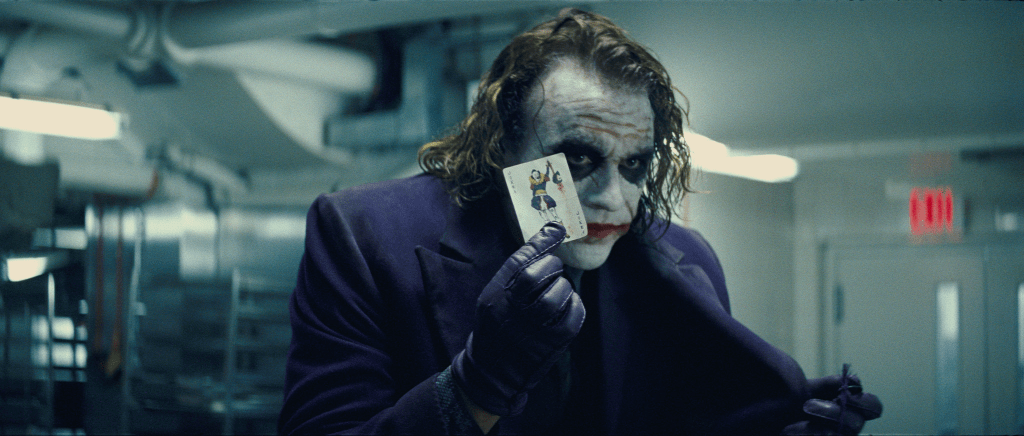
Everybody has that one film that made them who they are today. Regarding The Dark Knight, I always give this much-anticipated 2008 sequel all the credit for making me become the cinematic lover I am today. Nolan truly saved the franchise with Batman Begins. So, when it came time for a second installment, he took what he experienced while filming the first and made it even more gratifying. As crime overgrows in Gotham City, Batman and Jim Gordon ally with DA Harvey Dent to get rid of organized crime, which comes at the cost when the Joker makes a name for himself, testing the limits of what Batman’s willing to do to save his city.
I’ve known I’d love The Dark Knight ever since I saw it in a crowded theater, but I was curious to see how Nolan would alter the course of what a comic book movie can be. It has the attraction of a criminal drama rather than a straightforward action movie, and it is a darker and more flourishing Batman story than some of us thought was possible. Once again, Christian Bale is at the top of his game as Bruce Wayne/Batman. But one of the contributing factors why it’s the greatest is Heath Ledger’s posthumous Oscar-winning performance as the Joker. From his two introductions to the interrogation scene, Ledger is perfect in every scene, creating a character/portrayal of the iconic villain so clever, psychopathic, and creepily hilarious. And to think everyone doubted this casting decision and showed them wrong 100%. He was one of my favorite actors growing up, and it will never be the same that he passed away and never got to see this performance.
Aside from the performances, Nolen improved significantly on the action, especially implementing more practical effects like jaw-dropping truck-flipping moment, taking on a mature and grounded tone from Begins. In noting the relationship between Batman and Joker, it doesn’t get any better when it cares to see where the Joker is coming from, believing he and his Caped Crusader counterpart are more similar than they think. Except where Batman is a pivotal hero, the Joker is the so-called “Agent of Chaos” who doesn’t take rules into order. And we can’t count out Aaron Eckhart as Harvey Dent/Two-Face as a great secondary antagonist who wouldn’t expect to turn against what he stood for, thanks to the Joker’s plan.
There’s never a moment that screams dull in a perfectly paced two 1/2-hour runtime when you know every detail is essential. Even the technical aspects of Wally Pfister’s breathtaking cinematography to Hans Zimmer and James Newton Howard’s score are flawless in a film that has redefined how we view blockbusters on this scale. And though it’s a film that had fans and critics come together, how was it not nominated for Best Picture? Gritty, more profound, and thrilling than its predecessor, The Dark Knight not only takes the crown as Christopher Nolan’s best film but might be the most outstanding film of the 21st century.
FULL REVIEW—> RIGHT HERE
 TV and City