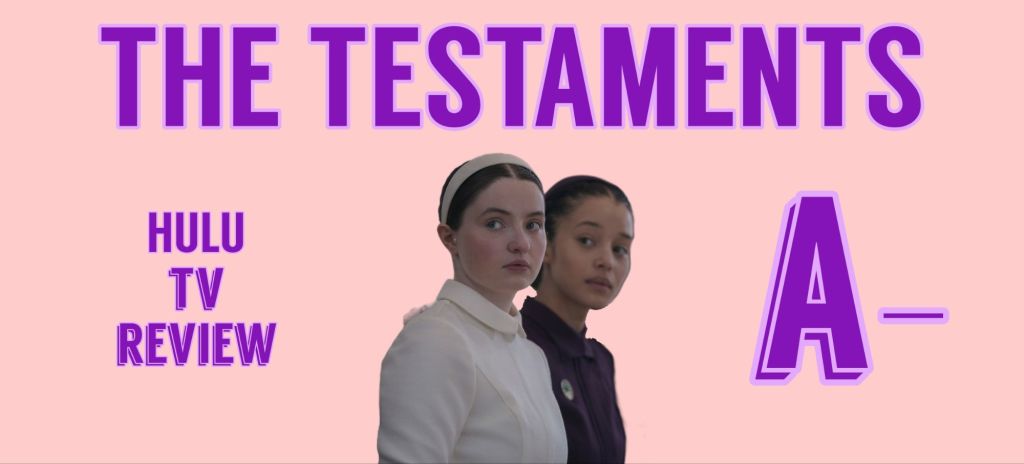
The Testaments premieres April 8 on Hulu.
By Elazar Abrahams
Hulu’s The Handmaid’s Tale let viewers spend years learning and fearing the world of Gilead, a religious dictatorship in what was once the United States. Its new sequel series, The Testaments, drops us back into that dystopia in a decidedly smaller-scale story, at least for now, centered on a group of young women growing up inside the regime.
Spinoffs are a tough sell, but this one is really well done. It pulls you in quickly, and feels like a worthy successor to its predecessor.
The biggest shift from the original series is the perspective. Unlike The Handmaid’s Tale, where so much of the tension came from characters who still remembered the world before Gilead and were fighting to escape it, the protagonists here are young enough that this oppression is all they have ever known.
The story follows Agnes (Chase Infiniti), who was raised in the system to be dutiful and cautious, and Daisy (Lucy Halliday), a new arrival from sinful Canada, entering Gilead’s borders as a supposed convert, but harboring secrets. Their pairing is the throughline of the season, and both starlets are more than capable of feigning innocence and the loss of it.
The genre is almost “young adult,” but heavily leaning into the “adult.” After all, despite the boarding school-like setting, these girls are living inside an awful country that treats them as second-class citizens. They lack knowledge of most bodily functions, their options for the future are narrow, and their lives are governed by fear of execution. Interestingly, while of course a few menacing male characters are present, the focus is really on the core group of young women and the ways they begin to question, push back, and grow into themselves.
Fans of the novel this is based on should be warned to calibrate their expectations. The book version of The Testaments is stronger and structurally different. If you were hoping for a very literal translation of its triple narration structure, with certain characters not crossing paths until halfway through the plot, you may be disappointed. The series is a looser adaptation that reshapes the pacing to serve a multi-season arc, and align with the expanded world established by the prior show.
That bridge to The Handmaid’s Tale is a major asset, with the show explicitly connecting to characters viewers already know. Without spoilers, the season has several surprises that reward longtime fans.
Infiniti is compelling as Agnes, beginning the role as subdued and constrained, which is the nature of this environment. Over the course of the season, it becomes satisfying to watch these girls gradually come into their own, to watch small shifts in perspective become acts of rebellion.
But the clear highlight any time she’s on screen is Ann Dowd reprising her role as Aunt Lydia. Dowd’s screen presence is magnetic, and the show benefits immensely when it leans into Lydia as a complicated powerbroker rather than a simple villain. One wishes there were even more of her, because the series is at its sharpest when it’s letting Dowd control the air in the room.
Two episodes in particular stand out. Episode 6 is flashback-heavy and provides context to Gilead’s formation that feels distinct from what we’ve seen before. Episode 8 is another highlight, largely because it gives the audience a significant amount of Aunt Lydia content, and the cracks in several relationship dynamics begin to reach a peak.
The smaller scope is also a feature, not a bug. Compared to later-stage Handmaid’s Tale storylines, The Testaments starts in a more contained environment, an academy setting with a limited set of locations and a tighter cast. Some may see that as a downgrade, but the potential here actually feels large. After all, The Handmaid’s Tale began as an intimate story of one household and gradually widened into something bigger. This series feels positioned to do the same: start tight, establish the girls, establish the machinery around them, then expand outward once the emotional foundations are set.
Ultimately, The Testaments succeeds because it doesn’t try to recreate The Handmaid’s Tale beat for beat. It re-enters Gilead through a new lens, and it finds fresh tension in the idea of young people inheriting a world they did not choose. Fans of The Handmaid’s Tale will absolutely want to check this out, and even newcomers who know the basic backstory should be able to follow along.
I give The Testaments an A-.

 TV and City